- All
- Product Name
- Product Keyword
- Product Model
- Product Summary
- Product Description
- Multi Field Search


Car carpet production solution
Core equipment selection and process parameters
Carpet surface production tufting machine
Machine selection
Plain Cut Tufting Machine: Suitable for the production of automotive interior carpets and floor mats. It forms a flat suede surface by cutting the suede, which meets the high-precision appearance requirements of automotive interiors.
Plain Loop Tufting Machine: It forms a looped suede structure to enhance the wear resistance of the carpet surface. It is often used in high-wear areas such as automotive floor mats.
Key process parameter
Process parameters | Recommended values | Application scenario |
Gauge | 5/64"(2.0mm)1/10"(About 2.54mm) | Small needle pitch achieves high-density tufting (needles/inch ≥32), adapted to the compact space requirements of automotive interiors, and the pile height can be controlled at 3-8mm to avoid affecting the operating space in the car. |
Pile height | 3-8mm | Low pile height design reduces dust accumulation, facilitates cleaning, and reduces the impact on pedal travel. |
Tufting density | ≥2000 needles /㎡ | High-density structure improves wear resistance and meets the anti-trampling requirements of automotive carpets |
Setting equipment
1. Heat setting machine
Working principle: Use high temperature (180-220℃) to set the surface of chemical fiber blanket, eliminate stress deformation during tufting, and ensure that the blanket surface maintains dimensional stability in the automotive environment of -40℃ to 80℃.
Process points: The setting time is controlled within 5-10 minutes, and the tension control system is used to avoid shrinkage or stretching deformation of the blanket surface.
2. Chemical setting equipment (optional)
For wool blended materials, a low-temperature chemical setting process is used to enhance the wrinkle resistance of the blanket surface through resin coating while maintaining a soft touch.
Adhesive treatment system (for foot pads)
1. TPR adhesive production line
Material characteristics: Black TPR (thermoplastic rubber) adhesive, Shore hardness 60-70A, both anti-slip (friction coefficient ≥ 0.6) and recyclability (100% thermoplastic recycling), in line with automotive industry environmental protection standards (such as ISO 14001).
Coating process:
Roller coating, the thickness of the adhesive layer is controlled at 0.8-1.2mm, forming a grid-like or granular anti-slip pattern.
Curing temperature 150-180℃, ensuring the peeling strength between the backing adhesive and the blanket surface ≥5N/cm.
2. Production process planning
Production process of automotive interior blanket surface
Yarn preparation:Preferred 150D-300D nylon 66 or polyester fiber yarn, breaking strength ≥5cN/dtex, light fastness ≥4 level (ISO 105-B02).
Tufting molding:Use 5/64" gauge flat shear tufting machine, set the tufting speed to 800-1200 rpm, and ensure that the suede flatness error is ≤1mm/㎡.
Heat setting treatment:The blanket surface passes through the heat setting machine, the temperature is 200℃, the conveyor speed is 1.5m/min, and the shrinkage rate after setting is controlled within ±1%.
Cutting quality inspection:The laser cutting machine cuts according to the model template, and the edge is hot-melt sealed to prevent de-line. The quality inspection items include density uniformity, color fastness, and friction resistance test (ISO 105-X12, ≥4 level).
Car mat production process
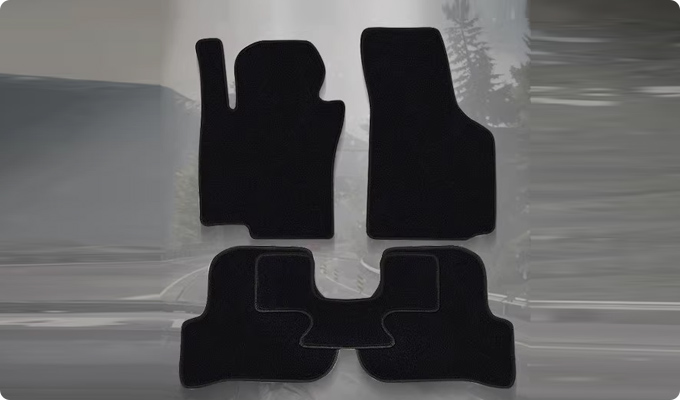
Tufting molding:Use 1/10" gauge flat loop tufting machine, with wear-resistant polypropylene yarn, tufting density ≥1800 needles/㎡, to enhance sand scraping performance.
TPR adhesive treatment: Secondary base fabric lamination process: first apply hot melt adhesive (weight 150-200g/㎡), then laminate TPR anti-slip layer, and form anti-slip bumps (height 2-3mm) through molding. Function test: Anti-slip test: Apply 100N horizontal force on a 15° slope, the foot pad displacement ≤5mm; Weather resistance test: -40℃ to 80℃ cycle 100 times, no cracking of adhesive.
3. Material selection and performance standards
Comparison of blanket surface materials
Material type | Advantages and characteristics | Application scenarios | Industry standards |
Nylon 66 | Strong wear resistance (wear resistance index ≥ 4000 revolutions), antistatic (surface resistance ≤ 10^9Ω) | Cockpit mats, trunk mats | ISO 10456 flame retardant standard (B1 grade) |
Polyester fiber | ood stain resistance (easy to clean), low cost | Passenger area interior carpet | GB/T 20285 flame retardant test |
Wool blend Soft touch | sound absorption and noise reduction (noise reduction ≥ 15dB) | High-end car interiors | OEKO-TEX® Standard 100 certification |
Environmental protection index of adhesive backing
Environmental protection parameters of TPR backing coating:
Heavy metal content: lead ≤10ppm, cadmium ≤5ppm (in compliance with ELV Directive 2000/53/EC).
Volatile organic compounds (VOC): formaldehyde emission ≤0.1mg/m³ (ISO 16000-9 standard).
4. Quality control and automation solution
(1) Key quality control points
Density uniformity: Sampling test every 100㎡, tufting density deviation ≤3%, real-time monitoring of tufting needle count by photoelectric sensor.
Temperature resistance: After being placed in a constant temperature box at 80℃ for 48 hours, the blanket surface has no fading or deformation; after being frozen at -40℃ for 24 hours, the adhesive backing has no cracking.
Flame retardant test: According to ISO 3795 standard, the burning rate is ≤100mm/min, and the self-extinguishing time is ≤15 seconds.
(2) Automated production plan
Intelligent tufting system: integrated PLC control system, supports CAD pattern import, automatically adjusts needle distance and color switching, and adapts to the rapid changeover production of carpets of multiple models.
Visual inspection equipment: AI visual system detects defects such as missing needles and color difference on the carpet surface online, with an inspection accuracy of ≥0.5mm.
Flexible cutting unit: six-axis robot equipped with water jet cutting, adapts to complex vehicle contours (such as curved pedal area), and has a cutting accuracy of ±0.5mm.
5. Capacity planning and cost reference
Equipment capacity calculation
Equipment type | Single machine capacity | Configuration recommendation |
TPR back coating line | 500-600㎡/ day | 1 unit (including adhesive coating + curing unit) |
Heat setting machine | 1200-1500㎡/ day | 1 unit (compatible with multiple materials) |
Cost structure (taking 1㎡ car mat as an example)
Item | Cost range (yuan) | Optimization direction |
Raw materials | 25-40 | Large-scale procurement of yarn and recycling of TPR back adhesive |
energy consumption | 3-5 | Heat setting machine adopts waste heat recovery system, saving 15% energy |
labour
| 5-8 | Automated production line reduces 30% of operating positions |
depreciation of equipment
| 2-3 | The equipment life is calculated as 8 years, and the annual production capacity is ≥ 50,000 m2 |
6. Extended application scenarios
Trunk mat: flat circle tufting + TPR adhesive combination, adding waterproof coating (waterproof pressure ≥ 1000mm), suitable for outdoor equipment storage needs.
Electric vehicle battery compartment sound insulation mat: tufted carpet surface composite EVA sound insulation layer, noise reduction ≥ 20dB, while meeting the battery compartment flame retardant requirements (UL94 V-0 level).
Commercial vehicle cab carpet: highly wear-resistant polypropylene material, with detachable modular design, easy to clean and maintain regularly.
 |  |
If you need to refine the plan for specific models (such as new energy vehicles, commercial vehicles), or understand the equipment supplier's selection suggestions, you can provide specific needs for further deepening.
