- All
- Product Name
- Product Keyword
- Product Model
- Product Summary
- Product Description
- Multi Field Search


Views: 0 Author: Site Editor Publish Time: 2026-02-27 Origin: Site


In carpet manufacturing, durability is rarely determined by face fiber alone. A carpet may look attractive on the surface, but if the backing system is unstable, the product will quickly show problems in real use: edge curling, dimensional change, poor tuft lock, backing separation, reduced comfort underfoot, or early failure under traffic. That is why, in modern carpet, carpet tile, and artificial grass production, coating is not just a finishing step—it is a performance-defining step. And this is exactly where a Multi-functional coating machine becomes essential.
At Matale Industry&Tech CO., Ltd., we work with customers who need more than “coating application.” They need stable bonding, repeatable quality, flexible process control, and equipment that helps them produce floor-covering products with stronger structure and longer service life. In our experience, the right multi-functional coating machine does much more than apply adhesive or backing compounds. It helps manufacturers improve durability, dimensional stability, tuft lock, surface performance, and production efficiency across different product categories—including broadloom carpet, carpet tiles, and artificial grass.
When people think about carpet performance, they usually focus on visible factors:
fiber type
pile height
texture and pattern
surface appearance
But in real manufacturing, the hidden structure often decides long-term value. The coating and backing layer influence:
tuft lock strength
layer bonding performance
dimensional stability
wear resistance under traffic
curl resistance
backing flexibility or rigidity, depending on product design
acoustic and underfoot feel characteristics
compatibility with secondary backing materials
For carpet tiles and artificial grass especially, backing performance is critical because the product must stay stable over time and under changing environmental conditions. If the coating is uneven, poorly penetrated, or inconsistently cured, performance problems show up sooner than expected—even if the visible face looks good at first.
A Multi-functional coating machine is a coating system designed to apply and control backing or functional layers across a range of substrate types and product structures. Unlike a basic single-purpose coater, a multi-functional machine is typically built to support different coating materials, application thicknesses, product widths, and process modes.
In practical production, this means one machine may be used for:
primary backing coating
secondary backing bonding
functional layer application
reinforcement-related coating steps
carpet tile or artificial grass backing treatment
process adjustment for different product grades or formulations
The “multi-functional” advantage is not only about versatility. It is also about control—the ability to apply the right amount of material, in the right pattern, at the right consistency, and under the right processing conditions.
One of the biggest causes of inconsistent carpet performance is uneven coating application. If one side receives slightly more compound and the other side slightly less, the finished product may show:
uneven backing stiffness
dimensional imbalance
curl or shape deviation
irregular tuft lock across the width
A well-designed multi-functional coating machine helps solve this by controlling:
coating gap
material feed consistency
application pressure
line speed coordination
transverse distribution across the web
This matters because durability begins with uniform structure. A carpet with balanced coating distribution behaves more predictably during curing, cutting, installation, and long-term use.
For tufted carpet, one of the most important hidden performance indicators is tuft lock—how securely the yarn is anchored within the backing structure. If tuft lock is weak, the carpet may suffer from:
fiber pullout
edge loss
reduced wear life
visible degradation in traffic areas
A multi-functional coating machine improves tuft lock by helping the coating material penetrate and bond correctly around the tuft base. This requires:
controlled viscosity handling
stable application quantity
proper pressure and spread behavior
repeatable process conditions from batch to batch
In simple terms, the coating must do more than “sit on the back.” It must interact correctly with the backing structure to reinforce the tufted construction.
Carpet and carpet tile products often include multiple layers:
face structure
primary backing
coating compound
secondary backing or reinforcement layer
If the bond between these layers is weak, common problems can include:
delamination
edge lifting
reduced dimensional stability
shorter service life under rolling or foot traffic
A multi-functional coating machine helps create stronger interlayer bonding because it enables better control over:
coating thickness
spread consistency
contact quality with backing materials
line synchronization before lamination or curing
This is especially important in carpet tile, where backing stability often defines installation performance and long-term shape retention.
Dimensional stability is one of the most critical performance factors for carpet tiles and many structured floor covering products. A dimensionally unstable backing may lead to:
shrinking or expansion
gapping between tiles
installation difficulties
corner lift or edge curl
A multi-functional coating machine improves dimensional stability by ensuring the backing layer is:
evenly distributed
structurally balanced
properly bonded to reinforcement or secondary materials
processed under consistent tension and coating conditions
When the coating system is applied consistently, the finished product is more likely to hold its designed shape during transport, storage, and installation.
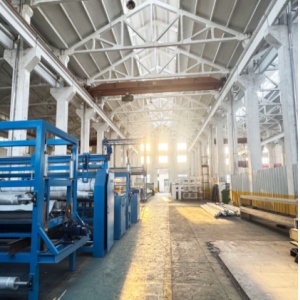
Carpet tile places particularly high demands on backing systems because the product is modular and must perform as individual pieces, not only as a continuous roll.
creating a more stable backing weight per square meter
improving tile flatness and reducing corner curl
supporting better layer adhesion in composite backing systems
improving cutting consistency after curing
allowing manufacturers to tune backing properties for different end uses (commercial, office, hospitality, education, etc.)
For modular flooring, backing precision is not a minor advantage—it is a core quality driver. Even small inconsistency in backing application can create visible installation issues later.
Although artificial grass is different from carpet in appearance and end use, the backing challenges are similar in one important way: durability depends on how well the backing supports the face structure.
In artificial grass, a multi-functional coating machine can improve:
yarn anchoring stability
backing consistency across wide widths
resistance to delamination
structural integrity during transport and installation
compatibility with different backing compound systems
Because artificial grass products are often installed in outdoor or semi-demanding environments, stable backing performance is essential for long-term product reliability.
Product Type | Key Performance Need | How a Multi-functional Coating Machine Helps |
Broadloom carpet | tuft lock + backing bond | improves coating penetration and layer adhesion |
Carpet tile | dimensional stability + flatness | controls coating uniformity and tile backing consistency |
Artificial grass | yarn anchoring + backing integrity | supports stable backing application and structural bonding |
Functional flooring products | added performance layers | enables controlled application of special coating layers |
A major advantage of a multi-functional coating machine is not only the coating itself, but the process control surrounding it. Better machine control helps manufacturers maintain:
stable line speed
repeatable coating thickness
controlled material usage
reduced batch-to-batch variation
cleaner transitions between products
And when production becomes more repeatable, product durability becomes more reliable.
In many factories, durability problems do not come from “bad material” alone. They often come from process instability:
coating too thick one day, too thin the next
pressure variation across width
inconsistent penetration
poor coordination between coating and curing steps
A multi-functional system reduces these variables.
So, how does a Multi-functional coating machine improve carpet durability and backing performance? It improves the hidden structure that makes surface products last: coating uniformity, tuft lock, layer bonding, dimensional stability, and backing consistency. For carpet, carpet tile, and artificial grass manufacturers, this means stronger products, fewer defects, more reliable performance, and better production control.
In today’s flooring market, durability is not created only by the face material—it is built from the back. And a well-designed multi-functional coating machine gives manufacturers the control they need to build that durability into every roll, tile, or turf product they produce.
To learn more about multi-functional coating machine solutions for carpet, carpet tile, and artificial grass production, you’re welcome to contact Matale Industry&Tech CO., Ltd. for more information and technical support.
It applies and controls backing or functional coating layers, helping improve tuft lock, bonding strength, and backing consistency.
Because uneven coating can cause dimensional instability, tile curl, poor flatness, and inconsistent installation performance.
Yes. It is often used to improve yarn anchoring, backing consistency, and structural bonding in artificial grass production.
By improving coating precision, layer adhesion, and backing structure—making the finished product more stable, durable, and reliable in use.