- All
- Product Name
- Product Keyword
- Product Model
- Product Summary
- Product Description
- Multi Field Search


Views: 0 Author: Site Editor Publish Time: 2026-02-28 Origin: Site


When people first hear the term Coating Machine, they often think of a simple device that “puts material on a surface.” In industrial manufacturing, however, a coating machine is much more than that. It is a key production system that controls how a functional layer is applied, how evenly it spreads, how well it bonds, and how consistently it performs from one batch to the next. In the flooring and surface materials industry, especially for carpet, carpet tiles, and artificial grass, a coating machine plays a direct role in product quality. It affects not only appearance, but also durability, backing strength, dimensional stability, tuft lock, wear resistance, and overall product function.
A coating machine is an industrial system designed to apply a controlled layer of material onto the surface or backside of another material. The purpose of that coating depends on the product, but in carpet and artificial grass production, the coating is usually applied to improve:
Backing strength
Tuft locking performance
Dimensional stability
Wear resistance
Moisture resistance
Surface or structural functionality
In simple terms, the coating machine helps transform a textile-based substrate into a more stable, durable, and application-ready product.
For example:
In carpet manufacturing, it may apply backing compounds that strengthen the structure and improve product life.
In carpet tile production, it may create a stable backing layer that helps each tile keep its shape and fit accurately.
In artificial grass production, it may apply backing materials that lock the fibers in place and improve installation performance.
So while the machine “applies coating,” its real purpose is much broader: it helps define how the final product performs in actual use.
Although different coating machines use different mechanical designs, the basic process usually follows the same logic:
Material feeding
The base material—such as carpet roll, carpet tile substrate, or artificial turf backing—enters the machine.
Coating material supply
The coating compound is prepared and delivered in a controlled amount.
Application
The machine applies the coating evenly using the chosen coating method.
Leveling and thickness control
The coating layer is adjusted to the required thickness or coating weight.
Drying or curing
Heat or other process controls help stabilize the coating.
Cooling, winding, or downstream transfer
The coated material moves to the next production stage.
The exact configuration depends on the material being produced and the type of coating being applied, but the purpose remains the same: stable, repeatable, and efficient coating performance.
A coating machine is especially important in these sectors because the coating is not only decorative—it is structural and functional.
In carpet production, the coating layer helps the product resist daily use, maintain structural strength, and perform consistently over time. A properly applied backing layer can improve:
bond strength between layers
shape retention
resistance to separation or deformation
product consistency in transport and installation
If the coating is uneven or weak, the carpet may lose performance much earlier than expected.
Carpet tiles require excellent dimensional stability. Because they are installed in individual modular pieces, even small size changes can create gaps, lifting, or poor alignment. A coating machine helps create a more stable backing system by controlling:
coating thickness
backing uniformity
balance across the tile
structural stiffness and flexibility
This is one of the main reasons coating quality is so critical in carpet tile production lines.
For artificial grass, the backing is where the fibers are secured. If the backing system is weak, the tuft lock may be poor, reducing product life and installation reliability. A coating machine helps improve:
tuft binding strength
backing integrity
flexibility for installation
long-term surface performance
In many projects, this is one of the most important performance factors for artificial turf.
A modern coating machine often does more than “apply one layer.” Depending on the design, it may support multiple production goals.
Function | What It Helps Improve | Typical Relevance |
Back coating | Structural backing strength | Carpet, carpet tile, artificial grass |
Pre-coating | Surface preparation for later layers | Carpet tile lines |
Tuft lock improvement | Fiber retention | Artificial grass, tufted carpets |
Dimensional stabilization | Shape consistency | Carpet tiles |
Surface functional layers | Additional performance features | Specialty flooring materials |
Drying and curing integration | Production speed and coating consistency | All continuous lines |
This is why many buyers now focus on multi-functional coating machine solutions rather than single-purpose systems.
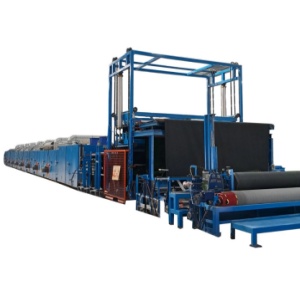
Not every coating machine applies material in the same way. The right method depends on the coating compound, product structure, and required output quality.
Common coating approaches include:
knife coating
roller coating
scraper or doctor blade systems
reverse roll systems
specialized backing application systems for textile substrates
Each method offers different advantages in terms of:
coating thickness control
production speed
material handling
waste control
surface smoothness
For carpet and turf applications, the key is usually not just the method itself, but how well the machine controls coating weight and consistency across the full width.
In real production, many quality problems come from inconsistent coating rather than insufficient capacity.
If coating is not stable, you may see:
uneven backing thickness
poor dimensional balance
inconsistent tuft lock
waste of coating compound
drying problems
product variation between batches
A good coating machine helps prevent these issues by controlling:
feed rate
coating gap
line speed
temperature
coating distribution
This is especially important in export manufacturing, where product consistency affects customer trust and repeat orders.
When evaluating a coating machine, it helps to look beyond the headline production speed and focus on the process-critical sections.
This is where the actual application happens. Precision and adjustability are critical.
Stable feeding and line movement help prevent wrinkles, tension issues, and coating variation.
A strong drying system helps stabilize the coating and improve line efficiency.
Heating method affects drying speed, energy use, and coating behavior.
A good control system improves repeatability, operator convenience, and production stability.
The machine must match your product width, target throughput, and future expansion plans.
Item to Check | Why It Matters | What to Confirm |
Product type | Different products need different coating behavior | Carpet, carpet tile, or artificial grass |
Coating material | Affects machine design and drying | Viscosity, curing behavior, material compatibility |
Coating width | Determines line compatibility | Maximum working width |
Coating thickness range | Controls product performance | Minimum and maximum coating weight |
Drying system | Impacts line speed and consistency | Heating type, drying capacity |
Production speed | Impacts output planning | Stable operating speed, not only max speed |
Control precision | Affects repeatability | Thickness adjustment, line synchronization |
Maintenance accessibility | Reduces downtime | Cleaning, inspection, replacement convenience |
In many factories, buyers are moving toward more flexible equipment because product lines are changing faster than before. A multi-functional coating machine offers several advantages:
one machine can support multiple product categories
easier switching between backing processes
better equipment utilization
reduced investment in separate lines
more flexibility for new product development
For manufacturers handling both carpet materials and artificial turf backing, this flexibility can be a major operational advantage.
So, what is a coating machine? In practical manufacturing terms, it is the process equipment that applies, controls, and stabilizes functional coating layers that directly influence the final product’s durability, performance, and usability. In the carpet, carpet tile, and artificial grass industries, a coating machine is not just used to add material—it is used to build structural strength, improve dimensional stability, enhance tuft lock, and support more reliable, higher-quality production. That is why choosing the right coating machine is such an important decision for any factory that wants to improve product performance and maintain consistent output.
At Matale Industry&Tech CO., Ltd., we understand that buyers are not only looking for machinery—they are looking for stable production, flexible application capability, and long-term manufacturing value. If you are evaluating a Coating Machine for carpet, carpet tile, or artificial grass applications, and want to better understand which machine configuration best fits your line, you are welcome to learn more through Matale Industry&Tech CO., Ltd. and contact our team for further product and technical information.
A coating machine is used to apply backing or functional coating layers that improve carpet durability, structural stability, and overall product consistency.
It helps control backing thickness, improve dimensional stability, and create a more consistent structure, which is critical for modular carpet tile installation and long-term performance.
Yes. In artificial grass production, a coating machine is commonly used to apply backing materials that improve tuft lock, structural integrity, and installation reliability.
You should check product compatibility, coating width, thickness control range, drying capacity, control precision, maintenance convenience, and whether the machine can support your current and future product plans.