- All
- Product Name
- Product Keyword
- Product Model
- Product Summary
- Product Description
- Multi Field Search


Views: 0 Author: Site Editor Publish Time: 2026-06-27 Origin: Site


Upgrading industrial textile and carpet manufacturing operations requires balancing initial machinery costs against long-term throughput gains. Relying on outdated machinery can stagnate growth in an increasingly competitive manufacturing landscape. Standard single-needle systems routinely struggle when operators attempt complex, multi-color, or varied-height designs. This limitation forces inefficient secondary passes, slowing down operations and drastically increasing material wear.
We will provide a transparent, evidence-based breakdown showing how dual-bar systems directly impact key production metrics. You will also learn the practical implementation realities buyers must carefully consider before procurement. By understanding the mechanical differences and production thresholds, you can make informed capital expenditure decisions. This guide empowers facility managers and procurement teams to evaluate upgrading options confidently.
Throughput Scaling: Dual-bar systems eliminate secondary passes in complex designs, directly increasing yield in heavy-duty applications.
Pattern Capability: Unlocks advanced cross-over patterning and high-low *loop pile production* without sacrificing stitch integrity.
Equipment Variations: Buyers must choose between fixed needle bar and split needle bar configurations based on specific cornering and pattern requirements.
Implementation Reality: Higher efficiency comes with stricter maintenance protocols; operator training for thread tensioning and needle calibration is critical to realizing ROI.
Traditional single-needle machines throttle output significantly when handling intricate patterns. Manufacturers often encounter severe bottlenecks as soon as design requirements move beyond basic, flat constructions. To achieve multi-color integration or textured high-low effects, operators must run the same material through the machine multiple times. They frequently intervene manually to adjust yarns or reposition the primary backing. This constant stopping and starting destroys production momentum. You cannot scale volume efficiently when your floor teams spend hours resetting machines for secondary passes.
Secondary passes also introduce massive material stress in heavy applications. Processing thick upholstery, dense area rugs, or industrial carpets multiple times compromises the structural integrity of the primary backing material. Every time a needle punctures the fabric, it severs or displaces the woven fibers. Doing this twice or three times over the same area causes the backing to weaken, fray, or even tear under tension. Wasted material piles up. Your quality control teams will end up rejecting a higher percentage of finished goods due to backing distortion.
Transitioning to multi needle tufting stands as a mandatory step for facilities looking to scale volume. It allows you to multiply your output without expanding your physical footprint. You eliminate the dreaded secondary run entirely. Operators feed the backing through the system once, and the machine handles complex stitching concurrently. This upgrade transforms a chaotic, multi-step workflow into a streamlined, predictable production line.
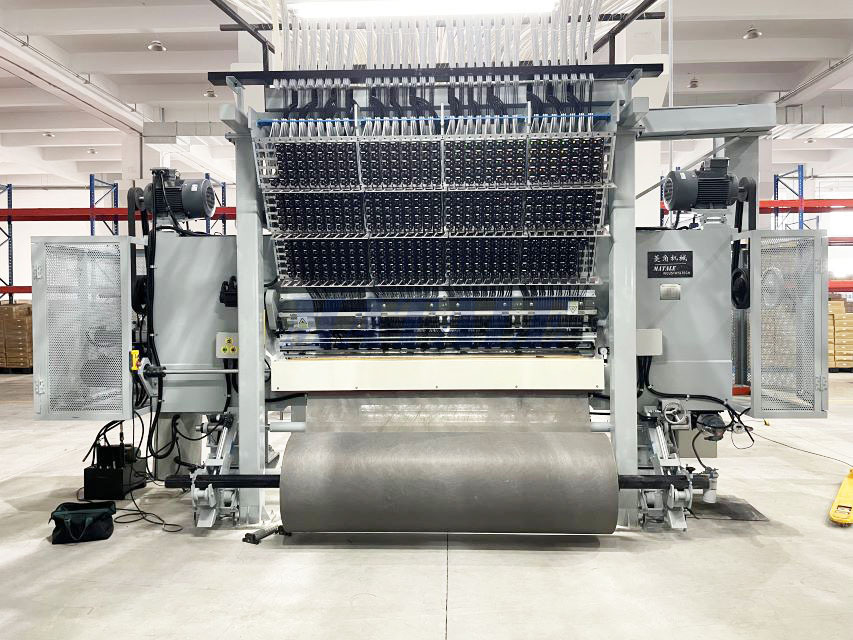
The primary advantage of these upgraded systems lies in their simultaneous action. Two parallel rows of needles operate concurrently to double stitch density. They seamlessly integrate secondary yarns in a single, fluid motion. Instead of relying on a single bar to punch down every thread, the workload is distributed. The front and rear bars synchronize, enabling overlapping stitches or distinct color insertions without compromising machine speed. This simultaneous action represents a massive engineering leap over older models.
Buyers must carefully navigate the choice between fixed and split needle bar configurations. Each style serves a very distinct manufacturing purpose.
Configuration Type | Primary Mechanism | Best Use Cases | Operational Strengths |
|---|---|---|---|
Fixed Needle Bar | Both needle bars move together in a rigid, unified structure. | Broadloom carpets, artificial turf, long straight runs. | Maximum high-speed stability and uniform heavy-duty stitching. |
Split Needle Bar | Bars can disengage or shift independently of one another. | Automotive upholstery, custom geometric rugs, sharp cornering. | Pivoting capability, complex pattern integration, sharp directional changes. |
A fixed bar excels during long, continuous runs. It guarantees extreme uniformity across massive rolls of broadloom carpet. Conversely, a split bar proves essential for sharp corners, pivoting, and complex geometric patterning. It allows one bar to disengage while the other turns, preventing thread bunching at corner points.
These machines also deliver unmatched precision in loop pile production. Mechanical stability sits at the core of this precision. The rigid framing and synchronized looper hooks prevent yarn pull-back. When machines run at high speeds, yarn tension fluctuates wildly. Older systems often fail to hold the loop in place as the needle retracts, resulting in uneven surfaces. Dual-bar mechanisms clamp and secure the yarn instantly. They ensure your pile heights remain perfectly consistent, even when the machine operates at maximum RPM.
Upgrading your machinery delivers rapid, measurable changes to your baseline metrics. The most immediate impact appears in labor and cycle time reduction. Finishing a complex, multi-color rug in a single pass rather than two cuts production time by exactly half. Your floor operators spend less time monitoring repetitive runs and more time staging the next batch of raw materials. This acceleration opens up schedule capacity, allowing you to take on larger volume orders without running costly weekend shifts.
Furthermore, single-pass efficiency minimizes costly errors. It drastically reduces raw material waste.
Elimination of Backing Distortion: Running fabric through a heavy machine once preserves its structural grid, preventing warping.
Reduction in Thread Breakage: Optimized tension pathways handle yarn gently, preventing snaps that halt production.
Fewer Off-Quality Rejects: Consistent pile heights and precise color placement mean more products pass strict quality control inspections.
Lower Scrap Rates: Operators discard fewer ruined edge pieces because the synchronized needles maintain straight, perfect lines.
Beyond waste reduction, this technology unlocks serious product line expansion. Upgrading your carpet tufting equipment allows manufacturers to confidently bid on premium, high-density contracts. You can easily produce mixed-texture designs, blending cut pile and loop pile in the same run. Clients demand rich, textured floor coverings and intricate upholstery. Having the right machinery ensures you never have to turn away lucrative custom orders due to technical limitations.
High-efficiency equipment introduces a new layer of calibration complexity. Doubling the needles literally means doubling the tension points. You cannot apply single-bar maintenance logic to a dual-bar system. Poor calibration leads directly to cascading thread breaks. If the front bar pulls yarn at a slightly different tension than the rear bar, the entire pattern skews. Technicians must meticulously balance the thread pathways before every major run to ensure flawless execution.
Your team will also face a noticeable operator training curve. Standard machine operators require dedicated upskilling to manage these advanced systems safely. They must learn complex dual-threading pathways. They need to understand the timing of split-bar pivoting to avoid needle collisions. Modern machines rely heavily on digital interfaces. Operators must practice inputting advanced software parameters and reading digital tension diagnostics. You must schedule buffer time for this training phase to prevent initial production dips.
Finally, managers must acknowledge the increased maintenance overheads. Running twice the needles generates significantly more friction and heat. You will experience an increased frequency of needle replacements. Worn needles damage yarn and create jagged loops. You must also invest in premium industrial lubricants. Standard oils break down quickly under the extreme heat generated by continuous dual-bar production environments. Preventive maintenance schedules must become stricter, requiring dedicated downtime to clean lint buildup and lubricate moving parts properly.
Not every facility requires this level of mechanical complexity. You must define your specific volume thresholds before committing to a purchase. Calculate the exact production volume, measured in units per week or total square meterage, where the new system breaks even. If you only run complex patterns once a month, a standard machine might suffice. However, if multi-color or high-density goods make up more than thirty percent of your output, the single-pass efficiency will justify the upgrade rapidly.
Feature-to-outcome mapping remains critical when selecting your specific model. Your daily production focus dictates the exact features you need. If your primary focus revolves around large-scale flat carpets, you should prioritize high-gauge, fixed-bar models equipped with robust motor capacities. These machines handle relentless, heavy-duty straight stitching. Conversely, if your core business involves custom rugs or highly detailed automotive upholstery, you must prioritize software-integrated split-bar systems. The pivoting capability is non-negotiable for those specific applications.
Vendor evaluation criteria must extend beyond the machine's spec sheet. When purchasing a double needle bar tufting machine, you are entering a long-term partnership.
Evaluate the comprehensive OEM warranties. Ensure they cover the complex computerized tensioning components.
Verify the immediate availability of replacement parts. A broken split-bar mechanism can halt your entire facility if parts take weeks to ship.
Review the vendor's Service Level Agreement (SLA) for technical support. Look for guaranteed response times and remote software troubleshooting capabilities.
Implementing dual-bar machinery represents a massive strategic leap for industrial textile manufacturers. It serves as a definitive tool for scaling throughput and completely unlocking premium product tiers. By eliminating the structural damage and time waste of secondary passes, facilities can dramatically increase their operational efficiency and product quality.
To successfully integrate this technology into your workflow, take the following next steps:
Conduct a comprehensive audit of your current production bottlenecks to identify exactly how much time is lost to secondary machine passes.
Request a customized ROI calculation from shortlisted equipment manufacturers, using your exact facility metrics and material costs.
Arrange a physical trial run with your preferred vendor using your own backing materials and yarn to verify tension handling and pattern accuracy.
Develop a dedicated upskilling roadmap for your senior operators, ensuring they master the digital interfaces and dual-threading mechanics before installation.
A: A split needle bar provides exceptional mechanical cornering ability. It allows the two needle rows to separate, making it perfect for complex geometric patterns and sharp pivots. A fixed needle bar locks both rows together. It delivers high-speed, straight-line efficiency, which is ideal for uniform products like broadloom carpets.
A: No. While the initial needle density increases, eliminating secondary passes actually reduces overall stress on the primary backing. By finishing the pattern in a single run, the fabric avoids the repeated structural trauma of multiple punches, provided the machine is properly calibrated.
A: Modern systems feature advanced, automated tensioning software to monitor threads dynamically. However, doubling the needles doubles the tension points. Manual baseline calibration by an experienced technician remains strictly necessary during initial setup to prevent cascading thread breaks and ensure pattern accuracy.