- All
- Product Name
- Product Keyword
- Product Model
- Product Summary
- Product Description
- Multi Field Search


Views: 0 Author: Site Editor Publish Time: 2026-03-10 Origin: Site


In carpet manufacturing, the visible surface may win attention first, but long-term product performance is often decided underneath. A carpet tile can look attractive on day one, yet if the backing lacks strength, dimensional stability, or balanced flexibility, it may curl, shift, wear unevenly, or fail under daily traffic. The same principle applies to artificial grass and related floor covering products: surface appearance matters, but performance depends heavily on what happens in the backing and coating stage. That is why the Carpet tile coating machine is such a critical piece of equipment in a modern coating line. It is not simply a machine that “adds material” to the back of a product. It is a process control system that helps manufacturers improve the durability, performance, and functionality of carpets, carpet tiles, and artificial grass by applying backing compounds in a controlled, repeatable way.
A Carpet tile coating machine is used to apply a controlled layer of coating compound to the back of a carpet tile substrate, carpet backing structure, or artificial grass product. This coating layer can serve multiple purposes, including:
improving dimensional stability
strengthening the backing structure
increasing wear resistance
enhancing adhesion between layers
adding weight, rigidity, or flexibility depending on the formulation
improving functional performance for installation and long-term use
In practical production, the coating machine is part of a broader line that may include:
material feeding
tension control
coating application
thickness regulation
heating or drying
cooling and winding / cutting
The machine itself is the core unit where coating material is metered and transferred to the product surface in a consistent layer.
The coating stage is where the product moves from “surface textile” to “functional flooring component.” Without proper backing treatment, carpet tiles may face problems such as:
poor dimensional stability
edge curling
weak layer bonding
inconsistent weight
reduced service life under foot traffic
For artificial grass, the same stage helps secure tufts and improve backing performance, which directly affects durability during installation and use.
That is why the Carpet tile coating machine is not just a production tool—it is a quality-defining machine. The coating layer helps determine whether the finished product can meet customer expectations for durability, strength, and long-term performance.
At its core, a coating machine works by doing four things in sequence:
Supplying the coating compound
Metering the coating amount
Applying the material evenly across the product width
Stabilizing the coated layer for the next production stage
This sounds simple, but each step must be tightly controlled. Even small variation in coating thickness can affect tile weight, product flatness, bonding strength, and final performance.
A typical working process looks like this:
Process Stage | What Happens | Why It Matters |
Material feed | Carpet substrate enters the line | Stable movement prevents defects |
Coating supply | Compound is delivered to the applicator | Consistent feed supports uniform coating |
Metering & spreading | Coating is distributed across width | Controls thickness and weight |
Surface leveling | Layer is smoothed and stabilized | Improves consistency and appearance |
Heating / drying | Coating begins to set or cure | Locks in structure and performance |
Cooling / discharge | Product stabilizes before next step | Prevents distortion and handling issues |
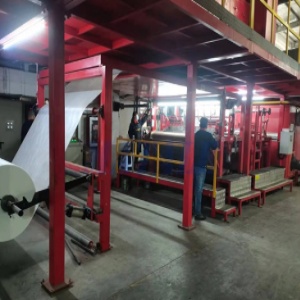
The process begins when the carpet tile base material or artificial grass backing enters the line. Before the coating even touches the product, the material must be fed smoothly and held in a stable path.
This part of the process typically includes:
unwinding or sheet feeding
alignment control
tension management
speed synchronization
If the substrate drifts, wrinkles, or stretches unevenly, the coating layer will not be applied evenly. That means good coating starts with good material handling.
The coating material—depending on the product design—is prepared and supplied to the machine. The machine must deliver this material at a stable rate. If supply fluctuates, coating thickness changes immediately.
At this stage, the line focuses on:
steady material delivery
temperature stability of the compound (if required)
smooth feeding into the coating head or applicator zone
The goal is to make sure the compound reaches the coating section in a consistent, workable condition.
This is the core function of the Carpet tile coating machine. The machine applies the coating compound onto the backing side of the product using a controlled spreading or transfer method.
At this point, the machine is responsible for:
maintaining even coating width
controlling coating thickness
preventing excess buildup
avoiding streaks, gaps, or uneven edges
The exact application method may vary by line design, but the purpose remains the same: to create a stable, uniform backing layer that supports the final product’s durability and performance.
Once the compound is applied, the coating layer must be leveled. This is where line precision becomes especially important. A backing layer that is too thick in one area and too thin in another can cause:
product warping
inconsistent tile weight
poor bonding performance
unstable finished dimensions
That is why thickness control is one of the most critical jobs in the coating line.
After coating, the product usually moves into a thermal zone where the backing layer begins to dry, set, or cure. This stage transforms the wet or semi-fluid compound into a stable functional layer.
This thermal process helps:
bond the coating to the substrate
stabilize the backing structure
achieve the target mechanical performance
prepare the product for cooling and cutting
Without proper heating or curing, even a perfectly applied coating may fail later in use.
After the coating has been stabilized, the product must cool before further handling. Cooling reduces distortion risk and helps the product maintain its final shape.
At this point, the line may proceed to:
winding
sheet cutting
tile cutting
stacking or inspection
The product is now much closer to its final market-ready form.
The reason manufacturers invest in a high-quality Carpet tile coating machine is not just speed—it is the performance gain in the finished product. A well-controlled coating process helps improve:
A stronger, more uniform backing helps the carpet or tile withstand repeated traffic, movement, and installation handling.
A stable backing reduces shrinking, curling, or shape change, which is especially important for carpet tiles that must fit precisely.
For multi-layer products, coating improves adhesion between components, reducing delamination risk.
Depending on the formulation, the coating stage can support added weight, stiffness, flexibility, or other target properties that improve product usability.
For artificial grass, the coating machine helps secure tuft structure and improve backing reliability during transport, installation, and use.
So, how does a Carpet tile coating machine work in a coating line? It works by turning a raw textile-backed product into a more durable, functional, and reliable finished material through controlled coating application, precise thickness management, and coordinated thermal stabilization. In practical manufacturing, this means stronger backing, better dimensional stability, more consistent product weight, and improved long-term performance for carpets, carpet tiles, and artificial grass. In other words, the coating machine is one of the most important systems for improving the durability, performance, and functionality of these products.
At Matale Industry&Tech CO., Ltd., we understand that coating quality directly affects finished product value. That is why we focus on coating equipment solutions designed to support stable application, reliable output, and better manufacturing consistency for modern flooring and artificial grass production. If you would like to learn more about coating line solutions, machine configurations, or how the right coating system can improve your product performance, you are welcome to explore more with Matale Industry&Tech CO., Ltd. and contact us for further information.
A Carpet tile coating machine applies a controlled backing layer to improve the durability, dimensional stability, and functional performance of carpet tiles, carpets, and artificial grass.
Because uneven coating can cause curling, unstable weight, poor bonding, and inconsistent product performance. Stable thickness helps ensure reliable final quality.
Yes. The same category of coating machine is commonly used to improve backing performance in both carpet tile and artificial grass production lines.
By applying a uniform backing layer that strengthens the product structure, improves adhesion between layers, and helps the finished product perform better during installation and long-term use.