- All
- Product Name
- Product Keyword
- Product Model
- Product Summary
- Product Description
- Multi Field Search


Views: 0 Author: Site Editor Publish Time: 2026-03-12 Origin: Site


Choosing the right Carpet tile coating machine is not only a machinery decision—it is a product performance decision. In carpet tile manufacturing, the backing process directly affects how the final tile behaves in storage, transport, installation, and long-term use. If the coating system is unstable, the problems show up quickly: uneven backing weight, poor dimensional stability, inconsistent tile flatness, weak bonding, higher waste, and slower production. On the other hand, a well-matched coating machine helps create carpet tiles that are more durable, more consistent, and easier to produce at scale. It can also support related applications such as carpet backing and artificial grass backing, where durability, structural stability, and functional performance are equally important.
Carpet tiles depend heavily on their backing system. Unlike roll carpet, carpet tiles must maintain accurate size, stable edges, and consistent stiffness so they can be installed piece by piece without gaps, curling, or movement. This makes the coating process especially important.
A good coating machine helps improve:
Dimensional stability
Backing strength and bonding consistency
Tile flatness and edge stability
Wear performance in use
Production repeatability from batch to batch
For manufacturers, this means the machine influences both product quality and operating efficiency. It is not only applying material—it is helping define how the final tile performs.
Before selecting a machine, the first question is not “Which model is best?” It is “What do we need this line to achieve?”
In most carpet tile plants, the coating machine is expected to do one or more of the following:
Apply a consistent backing layer to improve tile stability
Support pre-coating and final backing in a repeatable process
Improve product durability and long-term structural performance
Reduce waste through better coating control
Increase output without sacrificing coating consistency
Potentially support related products such as carpet rolls or artificial grass backing
If your factory is producing multiple product types, a more flexible or multi-functional coating machine may create more long-term value than a single-purpose line.
A coating machine must match the actual product structure you plan to run.
The main goals are:
stable backing thickness
uniform coating weight
dimensional consistency
reliable drying and curing
The focus may include:
backing reinforcement
product durability
consistent full-width coating
smooth continuous production
The machine may need to support:
stronger tuft lock
stable backing adhesion
consistent coating across heavier or more open substrates
This is why many buyers now prefer machines that can handle carpet, carpet tile, and artificial grass applications, especially when future product expansion is possible.
Product Type | Main Coating Goal | Why It Matters |
Carpet tile | Dimensional stability and backing consistency | Prevents gaps, curling, and installation issues |
Roll carpet | Structural backing and durability | Improves product life and handling stability |
Artificial grass | Tuft lock and backing integrity | Keeps fibers secure and improves functional performance |
Not every coating machine controls material the same way. In carpet tile backing production, thickness and coating weight must remain stable across the full working width.
Buyers should evaluate:
how the machine applies the coating
how precisely it controls thickness
how evenly the coating is distributed from edge to edge
how easily the settings can be adjusted for different products
This matters because even small variations in coating thickness can affect:
tile balance
backing stiffness
dimensional stability
drying consistency
material consumption
A machine with strong thickness control does more than improve quality—it also reduces over-coating and unnecessary cost.
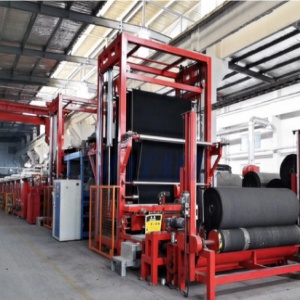
The machine must work with the coating materials your production uses now and may use later. Different backing compounds have different viscosities, spreading behavior, and drying requirements.
When choosing a Carpet tile coating machine, confirm:
the coating material range the machine can handle
whether it is suitable for current and future formulations
how the machine performs under different coating weights
how easy it is to clean during material changes
This is especially important for factories serving multiple markets, where customers may request different backing structures or performance levels.
Factor | Why It Matters in Production |
Viscosity range | Affects pumping, spreading, and thickness control |
Drying behavior | Impacts line speed and curing consistency |
Adhesion performance | Influences final backing strength |
Cleaning difficulty | Affects downtime during product changes |
A machine that is too small will limit your production. A machine that is too large may increase unnecessary cost and operating complexity. The right choice depends on:
your product width
target daily output
planned expansion
line balance with drying and downstream processes
Many buyers focus only on maximum speed, but in real production, the more important question is: What speed can the machine maintain while keeping coating stable?
A coating machine should be evaluated by:
practical working width
stable production speed
coating quality at operating speed
how well it matches the drying system
In carpet tile backing, drying is not a secondary detail—it is a critical part of the coating result. If drying is too weak or uneven, the line may experience:
unstable backing performance
surface defects
slow production speed
material sticking or incomplete curing
higher rejection rates
That is why a good Carpet tile coating machine should be considered together with its drying section.
You should check:
heating method
drying length and capacity
temperature stability
suitability for your coating material
line speed match between coating and drying
Drying Factor | Production Impact |
Insufficient drying | Slower line speed and unstable backing |
Uneven heating | Inconsistent product quality across width |
Poor temperature control | Risk of over-drying or incomplete curing |
Strong drying match | Better efficiency and more stable quality |
The machine should not only run—it should help improve the finished product. In carpet tile, carpet, and artificial grass production, coating equipment is often selected because it supports better end-use results.
A well-chosen coating machine can help improve:
Durability by creating a stronger, more stable backing system
Performance by improving dimensional stability, tuft lock, and structural consistency
Functionality by enabling specialized backing layers or performance-focused coatings
This is why many buyers now evaluate machines not only by mechanical design, but by what they can do for the final product’s market competitiveness.
Production needs change. A machine that only fits today’s narrow requirements may limit your options later.
When comparing systems, ask:
Can this machine handle more than one product type?
Can it support both pre-coating and final backing?
Can width, coating weight, or process settings be adjusted easily?
Can it be upgraded if our product mix changes?
A flexible line may cost more at the beginning, but it often delivers better value over the long term.
Choosing a Carpet tile coating machine for backing production is one of the most important equipment decisions a flooring manufacturer can make. The right machine helps create more stable carpet tiles, stronger carpet backing, and better artificial grass backing performance—all while improving durability, product consistency, and production efficiency. The best choice is not the most complicated machine, but the one that matches your materials, product goals, width requirements, drying needs, and long-term production plans.
At Matale Industry&Tech CO., Ltd., we understand that coating equipment must support both manufacturing efficiency and final product quality. That is why we always recommend evaluating a coating line by how well it improves durability, performance, and functional value across carpet, carpet tile, and artificial grass applications. If you are planning a new backing line or upgrading an existing one, you are welcome to learn more through Matale Industry&Tech CO., Ltd. and contact our team for further information about practical coating machine solutions.
The most important factor is whether the machine matches your actual production process, including product type, coating material, thickness control needs, drying requirements, and target output.
Yes, many modern systems can support carpet, carpet tile, and artificial grass applications, especially if they are designed as multi-functional coating machines with flexible process adjustment.
Drying affects curing consistency, line speed, and final backing quality. Poor drying can cause unstable backing performance, higher waste, and reduced production efficiency.
It helps create a more uniform and stable backing layer, which improves dimensional stability, structural strength, bonding consistency, and the long-term usability of the final product.