- All
- Product Name
- Product Keyword
- Product Model
- Product Summary
- Product Description
- Multi Field Search


Views: 0 Author: Site Editor Publish Time: 2026-07-05 Origin: Site


Acquiring an industrial carpet coating system represents a pivotal capital investment. This single decision dictates your daily production bottlenecks, material waste levels, and final product compliance. Today, tufted carpet manufacturing demands unprecedented operational flexibility from production facilities. Buyers now expect seamless handling of diverse backing compounds. They require machinery capable of processing everything from traditional latex to advanced polyurethane and thermoplastics. Simultaneously, operators must uphold strict environmental guidelines, such as CRI standards, to remain competitive. How do you navigate these competing operational pressures? You need a pragmatic, vendor-neutral framework. We designed this comprehensive guide to help you evaluate machinery based on long-term operational efficiency, technical viability, and facility integration risks. You will learn how to align machine capabilities with specific manufacturing requirements. We will explore core technical features, ranging from web tension controls to thermal efficiency. By understanding these variables, you can confidently select equipment optimizing uptime and ensuring premium carpet quality.
Selecting the right equipment requires aligning your specific tufted carpet coating compounds (e.g., secondary backing, action bac) with oven thermal capacity and tension control limits.
A multi-function coating line offers versatility for transitioning between broadloom and carpet tiles, but introduces complexity in operator training and maintenance.
True machinery cost is measured by factoring in energy consumption per square meter, downtime for compound changeovers, and parts availability, rather than just the initial purchase price.
Proper vendor evaluation must include verifiable proof of curing uniformity and edge-tension management to prevent post-installation failures like edge curling or delamination.
Start your evaluation by assessing current manufacturing bottlenecks. You must identify exactly what limits your facility right now. Are you trying to scale daily throughput? Perhaps you need to drastically cut utility bills. Or maybe you want to launch entirely new product lines. Shifting from standard latex broadloom to specialized commercial carpet backing alters machine requirements significantly. You must map these operational goals clearly before reviewing equipment catalogs.
Next, consider the ongoing trade-off between volume and versatility. High-speed, single-purpose machinery handles massive runs efficiently. It pushes out identical products hour after hour. However, it lacks crucial adaptability. Conversely, adaptable lines offer immense flexibility but often run at slower top speeds. You must determine where your business model fits on this spectrum.
Machine Configuration | Production Volume | Material Flexibility | Ideal Application Scenario |
|---|---|---|---|
Single-Purpose Line | Very High | Low | Dedicated standard broadloom manufacturing. |
Modular / Adaptable Line | Medium to High | Very High | Mixed facilities producing both rolls and tiles. |
Material compatibility requires careful documentation. You need to list every chemical compound processed in your facility. For instance, tufted carpet coating relies heavily on the primary coat's performance. This initial liquid application must aggressively lock the yarn bundles into the primary backing. Industry professionals call this metric the tuft bind. If this initial bind fails, applying a heavy secondary backing cannot save the product. Secondary backings, such as jute or action bac, require entirely different adhesion profiles. Your chosen machinery must handle these varied chemical viscosities effortlessly.
A premium carpet backing machine relies on robust engineering to ensure consistent quality. You should evaluate several critical subsystems.
Multi-zone web tension control remains absolutely non-negotiable. Carpet yarns naturally stretch and shrink when exposed to intense heat and moisture inside the ovens. Poor tension management immediately causes dimensional instability. Load cells and variable frequency drives (VFDs) must constantly communicate. If they fail, you will see visible "bow and skew" defects in the finished roll. Proper tenter frames grab the carpet edges and hold the fabric taut, preventing these costly distortions.
Applicator selection depends entirely on compound viscosity. You must choose the right application method for your specific chemicals.
Lick Roll Systems: These work beautifully for lower-viscosity compounds like standard SBR latex. They offer high-speed transfer. However, they can result in heavier penetration, occasionally wasting material if poorly calibrated.
Doctor Blade Systems: These excel in high-viscosity applications. They shear the compound flat across the carpet back. This method provides pinpoint precision and minimizes expensive compound waste.
Curing ovens ultimately dictate your maximum line speed. Modern equipment usually blends two heating technologies. Infrared (IR) heaters provide rapid surface heating. They flash off surface water quickly before the carpet enters the main chamber. Forced-air convection ovens do the heavy lifting afterward. They push hot air deep into the carpet matrix. This ensures uniform curing throughout the entire product thickness.
Exhaust heat recovery systems matter immensely for your long-term profitability. Ovens consume massive amounts of natural gas or electricity. Heat recovery units capture escaping thermal energy. They redirect this hot air back into the drying process. This simple loop dramatically reduces utility bills over the equipment's lifespan.
Modern automated systems use advanced Programmable Logic Controllers (PLCs). Operators can save exact compound application "recipes" directly into the touchscreen interface. This automation reduces changeover times significantly. It effectively eliminates human error during complex shift changes.
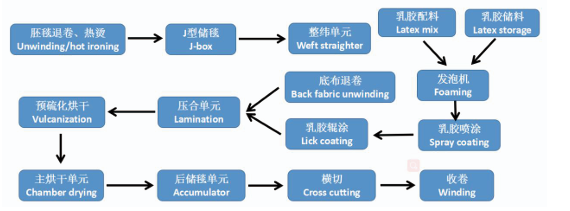
Many mid-to-large tier manufacturers currently face a strategic dilemma. Market demands shift rapidly. Facilities must pivot quickly between residential roll goods and modular commercial carpet tiles. Building separate facilities requires massive capital. Here, a multi-function coating line shines brilliantly. It solves the capacity problem under one roof.
The primary advantage lies in equipment modularity. You can physically swap out applicator units directly on the production line. Operators can run pre-coat latex in the morning. By afternoon, they can switch the cassettes to apply heavy PVC or bitumen tile backing. This agility keeps your business highly competitive. It allows you to accept diverse contracts without turning away lucrative custom orders.
However, you must view this adaptability through a skeptical lens. Adaptability comes at a steep price. Multi-function setups require a much larger physical footprint. The initial capital expenditure runs significantly higher than standard setups. Furthermore, these complex machines demand highly specialized maintenance personnel. Your technicians must understand fluid dynamics, thermal engineering, and complex mechatronics. Dedicated single-purpose lines usually operate more simply. You must weigh these operational realities against your projected revenue gains.
Buying the equipment is only half the battle. Installation introduces severe real-world facility constraints. You must plan for these disruptions early.
These industrial systems demand massive floor space. A fully equipped carpet back coating line often exceeds 50 to 100 meters in total length. You must account for large accumulators, known as J-boxes. These accumulators store excess carpet, allowing continuous oven running during roll changeovers. Extended curing ovens also consume prime real estate. Facilities must choose between straight-line and U-shape configurations. U-shapes save length but complicate web tension handling around the severe turns.
Prepare for hidden infrastructure upgrades. Upgrading your plant to handle massive utility loads gets expensive fast. You will likely need enlarged gas trains for the ovens. You might need heavier electrical switchgear for the drive motors. Upgraded compressed air systems are often mandatory for pneumatic actuators. Verify your site's exact utility capacities before placing any equipment deposits.
Curing compounds constantly release volatile organic compounds (VOCs). You must install robust exhaust ventilation systems. These systems capture hazardous emissions before they reach the factory floor. Maintaining strict environmental compliance ensures your products meet recognized standards. Achieving certifications similar to CRI Green Label Plus requires impeccable ventilation control.
Do not underestimate the human element during implementation. Advanced European or Asian equipment demands rigorous, localized training. You need clear, accurately translated documentation. Maintenance screens on the Human Machine Interface (HMI) must display native languages. Proper training keeps operators safe and maximizes equipment efficiency from day one.
Choosing the right manufacturing partner ensures your long-term success. You should evaluate potential vendors rigorously.
Always demand proof of concept before signing contracts. Vendors must run material trials using your own tufted greige goods. They must use your specific backing compounds. Generic showroom demonstrations tell you very little about real-world performance. Different yarns and chemical batches behave unpredictably under heat.
Evaluate the manufacturer's spare parts network deeply. A cheaper machine quickly becomes a major liability during a breakdown. If a proprietary tension sensor takes six weeks to ship internationally, your production halts completely. Ask vendors about their domestic inventory levels. Verify their guaranteed response times for remote software diagnostics.
Look past the simple "years" offered in the warranty brochure. Scrutinize coverage specifics carefully. Pay close attention to high-wear components. Applicator rolls, oven bearings, and main drive motors endure immense daily stress. Ensure the warranty covers these critical parts comprehensively.
Follow this actionable three-step plan to move forward:
Finalize your specific product specifications and calculate your required daily capacity needs.
Request detailed technical RFQs from vendors. Focus heavily on engineering details rather than just bottom-line pricing.
Conduct rigorous factory acceptance testing (FAT) at the vendor's facility before authorizing shipment.
Selecting an industrial coating system is fundamentally an exercise in risk mitigation. You must align the machine's capabilities seamlessly with your long-term product roadmaps. Navigating this high-stakes decision requires a clear understanding of your chemical compounds, facility constraints, and operational goals. Never over-index purely on top-speed metrics. Instead, focus entirely on consistency. Reliable tuft bind, uniform curing, and high operational uptime remain the true markers of a successful investment. We highly encourage you to consult technical sales engineers next. Request a comprehensive facility audit to determine your exact baseline utility needs before purchasing. Taking these deliberate steps ensures your new production line delivers profitable, premium carpets for decades.
A: With proper preventative maintenance, heavy structural components usually last 20 to 30 years. You should expect to upgrade the PLCs, sensors, and precision applicator heads every 7 to 10 years. Routine cleaning prevents premature wear on drive motors and bearings. Following maintenance schedules ensures maximum longevity and consistent product quality.
A: Tufted carpets require a much stronger primary pre-coat. This liquid coat physically locks the inserted yarns into the primary backing. We call this essential metric tuft bind. Conversely, woven structures interlock mechanically during the weaving process. They generally require less aggressive chemical binding to remain structurally sound.
A: It depends entirely on your existing drive controls and oven capacities. Adding modular coating heads remains physically possible. However, retrofitting often costs nearly as much as buying a new line. Outdated PLCs and mechanical tension controllers rarely integrate well into modern, modular application systems.
A: Edge curling usually stems from poor tension management or uneven oven heat. You must utilize edge-pinning technology, commonly known as tenter frames. These frames hold the fabric taut throughout the curing cycle. Precise temperature uniformity across the entire width of the curing oven also prevents localized shrinkage.