


Views: 0 Author: Site Editor Publish Time: 2026-09-02 Origin: Site


Commercial carpet manufacturing carries immense operational stakes. A single miscalibrated mass production run can waste thousands of yards of material and halt facility schedules. When managing the complex creel setup required for large-scale operations—often involving nearly 10,000 individual strands of yarn—precision is non-negotiable. The core problem lies in the translation gap between a two-dimensional digital CAD design and a three-dimensional textile. What appears perfect on a high-resolution monitor frequently shifts in scale, color, and texture when translated by industrial tufting equipment. To navigate this transition successfully, project managers rely on a rigorous sample approval process. Utilizing physical strike-offs and mockups forms a strict risk mitigation framework. This structured approach validates the exact capabilities of the machinery before authorizing full-scale manufacturing or overseas bulk orders. By demanding physical proof of concept, you ensure the final installed product matches the original architectural vision without compounding downstream errors.
Digital-to-Physical Validation: Sample approval bridges the gap between digital artwork and physical reality, proving the specific computerized tufting machine can execute the required pattern fidelity.
Risk Mitigation: Physical strike-offs prevent costly mass-production errors related to yarn tension, pile height inconsistencies, and color registration drift.
Standardized Evaluation: A structured approval sequence—from digital layout to physical color cards to final strike-off—establishes objective quality standards for the entire production run.
Installation Labor Mitigation: Because patterned carpets require specialized expertise and up to a third more time to install, approved samples and mockups ensure complex pattern matching aligns perfectly, preventing compounding labor costs on-site.
Establishing what constitutes a successful transition from design to mass production requires strict, measurable criteria. Success means zero pattern distortion, exact color matching under commercial lighting, and consistent pile density across the entire roll. Achieving this relies heavily on the precision of the Patterned Carpet Tufting Machine handling the production run. The equipment must translate abstract design concepts into durable, high-traffic floor coverings without losing the integrity of the original artwork. Every stitch must align perfectly to ensure the final product meets the exact specifications detailed in the initial project scope. We look for specific tolerances, usually within fractions of an inch, to confirm the machinery is hitting the mark. If the pattern drifts by even a quarter of an inch over a ten-foot span, the seams will never align during installation, resulting in a rejected floor.
A graphic carpet machine interprets CAD files through a specific pixel-to-stitch ratio. One pixel on a screen does not always equal one tuft of yarn on the floor. Digital renderings inherently lack the ability to accurately portray yarn luster, twist, and texture. A bright red pixel on a backlit monitor looks vastly different from a dyed nylon yarn tuft under fluorescent office lighting. The physical output is influenced by how the yarn absorbs and reflects light, how tightly it is twisted, and how densely it is packed into the primary backing. These variables make physical sampling an absolute necessity. You cannot approve a commercial flooring order based on a PDF file.
To illustrate the disconnect between screen and floor, consider the following translation variables that operators must manage:
Design Element |
Digital CAD Representation |
Physical Tufted Reality |
|---|---|---|
Color Matching |
RGB/CMYK values on a backlit monitor |
Yarn dye lots viewed under ambient room lighting |
Resolution |
Infinite pixel scaling and zooming |
Fixed needle gauge (e.g., 1/10 or 1/12 inch spacing) |
Texture |
Flat, two-dimensional rendering |
Three-dimensional cut or loop pile with varying twists |
Gradients |
Smooth, continuous color blending |
Stepped color transitions limited by yarn creel capacity |
Scale |
Easily resized with a mouse click |
Requires complete mechanical recalibration of feed rates |
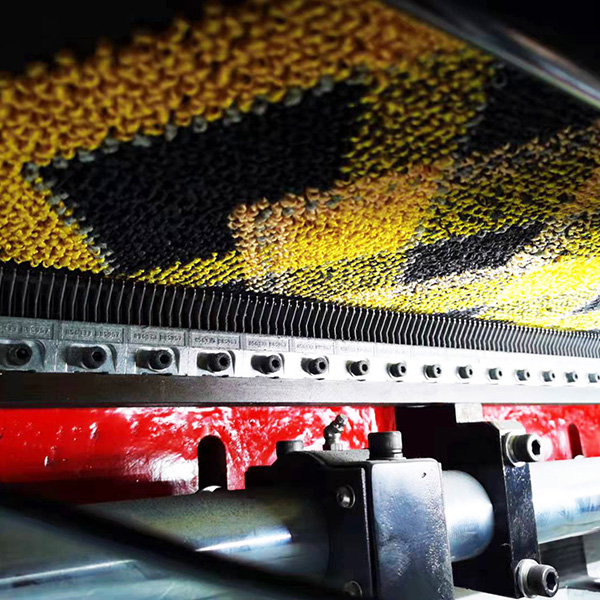
Modern computerized tufting machine technology dictates how needle gauge, stitch rate, and yarn feed mechanisms interact. The mechanical realities of the factory floor are complex. Massive creel setups feed thousands of individual thread strands into the machine simultaneously. If tension varies even slightly across the creel, the resulting pattern will skew. This is why physical calibration and precision loom weaving adjustments are required for every new design. Regardless of how sophisticated the software is, the mechanical components must be physically tuned to accommodate the specific yarn weight, backing material, and stitch density of the current project. Operators spend hours adjusting the yarn feed rollers and needle bars to ensure the physical output matches the digital intent. A machine running a heavy wool blend requires entirely different tension settings than one running a fine nylon yarn.
Moving a custom carpet from a digital file to a physical floor requires a strict sequence of approvals. Skipping any of these steps invites massive risk into the project timeline. We enforce a rigid workflow to ensure every stakeholder signs off on the physical reality of the product.
The approval process begins long before any yarn is threaded into the machine. The first step involves reviewing the exact-size digital layout provided by the manufacturer. This blueprint serves as the foundational map for the entire production run. During this stage, project managers must verify pattern repeats, scale, and border placements against architectural floor plans. Catching a scale error here prevents massive material waste later. The digital layout confirms that the design will actually fit the intended physical space without awkward cuts or misaligned seams.
When reviewing the CAD layout, you must check several specific elements against the site blueprints:
Overall room dimensions compared to the manufactured carpet roll width.
The exact location of the pattern repeat across the longitudinal seams.
Doorway transitions and how the pattern aligns with adjacent hard surface flooring.
Corridor intersections where patterns must turn, miter, or match perfectly.
Column dropouts and how the pattern flows around structural obstacles.
Once the digital layout is approved, the focus shifts to physical materials. Evaluating physical yarn samples, known as poms, is mandatory. Relying on Pantone or RGB/CMYK digital codes often leads to disastrous color mismatches. You must assess dye lot variances and select the appropriate yarn types based on the required commercial durability. Common choices include solution-dyed nylon for high-traffic areas or wool blends for luxury hospitality spaces. This stage also involves finalizing any specific OEM customization requests. Ensuring the raw materials meet the exact project specifications guarantees the final product will perform well under heavy foot traffic. We always request three separate dye lot samples to establish an acceptable range of color variation before production begins.
The physical strike-off is the definitive proof of concept. A strike-off is a small-scale physical sample, typically 1x1 or 2x2 meters, produced on the actual patterned carpet tufting machine slated for the mass run. This miniature production run exposes any hidden mechanical or translation issues. It allows designers and project managers to see exactly how the complex graphic patterns will look and feel in reality. The strike-off serves as the ultimate factory-level quality control benchmark. Once approved, it becomes the physical standard against which the entire bulk order is measured. We never authorize a full production run without a signed, physical strike-off in hand. It is the only way to verify that the factory equipment can actually execute the design.
Approving a strike-off requires more than a quick visual glance. You need to inspect the sample using the same rigorous standards applied to the final installation. Field experience shows that what looks acceptable on a desk often fails when rolled out on a 10,000-square-foot floor.
When evaluating the physical strike-off, pattern fidelity is the primary concern. Inspect the sample closely for stepping or jagged edges in curves and diagonal lines. High-quality machinery should produce smooth, continuous shapes. Verify that multi-color transitions are clean and entirely free of yarn bleed or tension pulling. If one color bleeds into another, or if the yarn appears stretched at the transition points, the machine calibration needs adjustment. The registration of the pattern must be crisp, ensuring that intricate details remain legible and visually striking from a standing height. Walk around the sample and view it from multiple angles to ensure the pattern holds its shape.
The structural feel of the carpet is just as important as its visual appearance. Measure the physical sample against the specified face weight and pile height. Use specialized tools to confirm the exact millimeter depth of the yarn. Evaluate the tactile feel and structural integrity of cut-pile versus loop-pile transitions. The texture should remain consistent across the entire sample. Any unexpected variations in density can lead to premature wear patterns once the carpet is installed in a commercial environment.
Field inspectors typically use the following tools to verify sample accuracy:
Pile thickness gauges to measure the exact height of the yarn above the primary backing.
Magnifying loupes to inspect individual stitch clarity and color separation at the base.
Light boxes to simulate different commercial lighting conditions, including fluorescent, LED, and natural daylight.
Density scales to confirm the face weight matches the architectural specifications exactly.
Moisture meters to ensure the backing adhesives have cured properly without retaining excess water.
Do not limit your inspection to the face of the carpet. Turn the sample over and inspect the primary and secondary backing application. The backing must be applied evenly, without dry spots or excessive adhesive buildup. Check any custom edge finishing on the sample for durability and neatness. Finally, test the sample for dimensional stability. The carpet must not stretch, shrink, or skew during the mass production curing process. Poor dimensional stability will cause the carpet to wrinkle or pull apart at the seams after installation. We often perform a manual stretch test on the strike-off to ensure the backing holds firm under tension.
Transitioning from a single approved sample to a full-scale production run introduces a new set of variables. Managing these risks requires strict oversight and clear communication with the manufacturing facility. You cannot assume the factory will automatically replicate the sample without explicit instructions.
The primary risk during transition is that the tufting machine settings drift between the sample run and the mass production run. Even minor changes in tension or speed can alter the final product. To mitigate this, mandate that the manufacturer locks in the servo motor profiles, yarn tension settings, and feed rates used for the approved sample. Documenting these exact parameters ensures the machine operates identically during the bulk run, preserving the approved quality standards. If the factory changes the needle setup for another job in between, they must recalibrate exactly to your documented specifications before starting your bulk order. Demand a setup sheet verification before they hit the start button.
Producing a perfect one-meter sample does not automatically guarantee a flawless 10,000-meter bulk order. The risk of pattern elongation or skewing increases significantly over long continuous rolls, especially during overseas bulk production. To mitigate this risk, establish acceptable tolerance percentages for pattern repeat variations over distance. Enforce strict factory quality control checkpoints throughout the production cycle. Inspectors should pull samples at regular intervals from the production line to verify that the pattern remains true to the original strike-off.
Here is a breakdown of common production risks and their corresponding field mitigations:
Production Risk |
Root Cause |
Required Mitigation Strategy |
|---|---|---|
Pattern Elongation |
Inconsistent primary backing tension during tufting |
Enforce strict tension control limits and measure pattern repeats every 100 meters. |
Color Drift |
Mixing different yarn dye lots mid-production |
Require the factory to allocate a single, continuous dye lot for the entire project order. |
Seam Mismatch |
Edge trimming variations at the factory |
Mandate factory-trimmed edges with a specified tolerance of less than 2 millimeters. |
Backing Delamination |
Improper curing temperatures in the finishing oven |
Request physical tear-testing reports from the factory's quality control department. |
Bowing and Skewing |
Uneven roller pressure during the coating process |
Implement laser alignment checks during the secondary backing application. |
Installation presents its own set of challenges. Patterned carpets inherently require more expertise and approximately one-third more time to install compared to solid colors. Misaligned seams exponentially increase labor costs and ruin the aesthetic of the space. Mitigate this by requiring a dry-lay mockup of multiple sample pieces prior to the actual installation. This mockup verifies seam alignment, demonstrates the final aesthetic effects, and sets definitive quality standards for the installation team. It provides a clear visual guide, eliminating guesswork on the job site. We always insist the lead installer signs off on the dry-lay mockup before a single drop of adhesive hits the floor.
Your project is only as successful as the manufacturing partner you select. Evaluating their technical capabilities and logistical competence is a critical part of the procurement process. Do not base your decision solely on the lowest bid.
Not all manufacturing facilities are equipped to handle complex designs. You must determine if a manufacturer's equipment is appropriate for the complexity of your specific project. Individually controlled needle tufting offers far greater precision for intricate, multi-color designs compared to traditional scroll tufting. Ask detailed questions about the age, maintenance schedule, and software capabilities of their machinery. Partnering with a facility that utilizes outdated equipment drastically increases the risk of pattern distortion and production delays. You want a partner running modern equipment capable of micro-adjustments on the fly. Request a facility equipment list to verify their technical capacity.
Navigating the logistics of international manufacturing requires meticulous planning. You must ensure that all sample specifications, raw materials, and OEM customizations translate perfectly to bulk overseas production. Communication is critical. Provide clear, documented standards for every aspect of the carpet, from yarn twist levels to backing adhesives. Establish a clear chain of custody for the approved strike-off, ensuring the factory floor managers have direct access to the physical sample during the entire production run. We recommend hiring a third-party inspector to visit the overseas facility and verify the bulk run against your approved strike-off before the shipping containers are loaded. Catching an error at the factory is infinitely cheaper than catching it at the job site.
The sampling phase requires balancing the time required for multiple strike-off iterations against strict project deadlines. Rushing this phase often leads to catastrophic errors later. Understand the upfront costs associated with custom sampling. While producing multiple physical strike-offs incurs initial expenses, it provides a massive long-term return on investment. Error-free mass production and streamlined installation easily offset the upfront sampling costs. View the sampling phase as an insurance policy against massive material waste and project delays. A few extra weeks spent dialing in the strike-off will save months of litigation and replacement work down the road. Build this sampling time into your master project schedule from day one.
Request a detailed sampling timeline and a full CAD layout from your manufacturer before signing any bulk production agreements.
Demand physical color cards and yarn poms to verify exact color matching under your specific commercial lighting conditions.
Insist on a physical strike-off produced on the exact machine slated for your mass production run to confirm pattern fidelity.
Schedule a dry-lay mockup with your installation team to verify seam alignment and establish quality standards before applying any adhesive.
A: A carpet strike-off is a physical, small-scale prototype produced on the actual manufacturing equipment. It is used to verify design accuracy, color matching, pile height, and edge finishing before authorizing a full-scale mass production run.
A: The standard timeline typically ranges from two to four weeks. This duration depends heavily on raw yarn availability, specific OEM customization requirements, and the overall complexity of the digital design being translated into a physical textile.
A: Physical samples differ because digital screens cannot replicate yarn texture, twist, or luster. Additionally, ambient lighting heavily influences perceived color, and the mechanical translation of square pixels into tufted stitches alters the visual output.
A: A pattern repeat is the distance before a design duplicates itself across the carpet roll. It is critical for estimating material waste accurately and ensuring seamless pattern matching during the final installation.
A: Yes, patterned carpet takes approximately one-third more time to install. It requires specialized expertise to ensure exact pattern matching at the seams, making pre-production dry-lay mockups vital for controlling labor costs.
A: No, machines have mechanical limitations. Constraints include minimum stitch resolution, maximum color limits per needle bar, and difficulties rendering smooth gradient transitions. Designs must be specifically optimized for the tufting process.
A: A complete submittal package must include the exact-size CAD layout, physical yarn color poms, the approved physical strike-off, detailed backing specifications, and a comprehensive technical specification sheet.