


Views: 0 Author: Site Editor Publish Time: 2026-10-17 Origin: Site


In the fiercely competitive landscape of commercial textile manufacturing, the distinction between a premium carpet and a subpar rug frequently boils down to a single mechanical parameter. Operational speed changes everything. The plain cut tufting machine serves as the undisputed workhorse of the modern flooring industry. While these robust systems are engineered for high-volume efficiency, the specific calibration of the backing feed speed ultimately dictates the structural integrity and aesthetic value of the finished product.
Backing feed speed represents the exact rate at which the primary backing fabric travels through the needle zone. Understanding the intricate dynamics between this feed velocity, stitch density, and yarn tension is absolutely essential for plant operators. This technical guide breaks down the mechanical realities of tufted carpet construction. We will explore how subtle speed adjustments transform the tactile feel of a room and optimize factory equipment for flawless production.
Recent market analyses reveal a significant pivot in global carpet manufacturing. Fluctuating raw material costs are forcing production facilities to minimize yarn waste without sacrificing luxury appeal. Consequently, the industry is moving rapidly away from manual gear adjustments. Modern factories now demand digital, servo-driven feed controls. This technological leap allows technicians to execute real-time micro-adjustments without ever stopping the production line.
By analyzing live production metrics, plant managers can optimize the backing feed rate to achieve premium plushness while reducing raw material consumption. This data-driven approach is no longer just an operational upgrade. It has become a baseline requirement for staying competitive in the high-end broadloom sector.
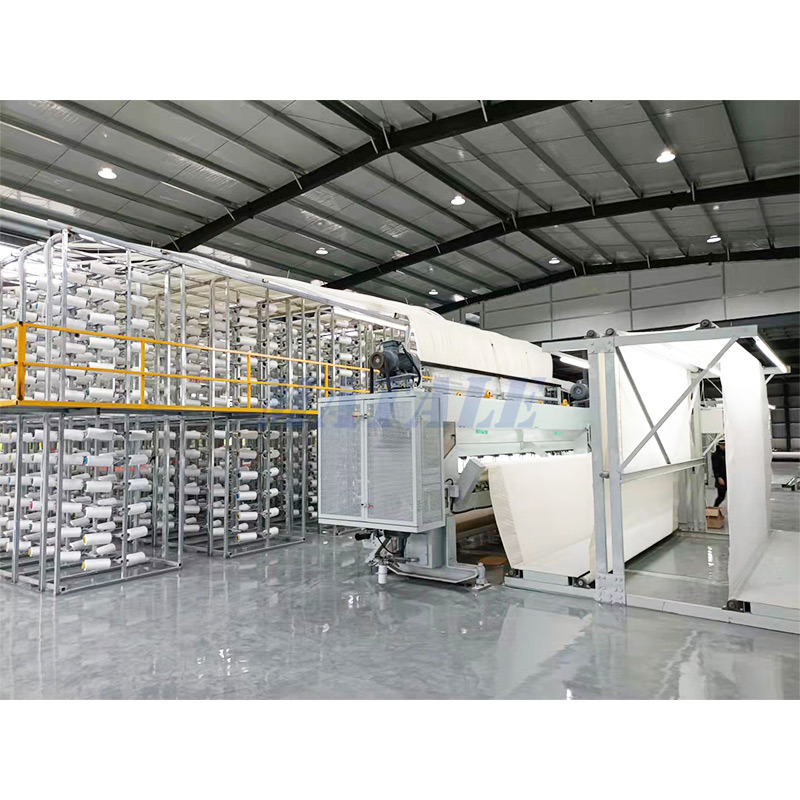
To master calibration, you must first understand the equipment's core anatomy. The advent of automated tufting shifted production from labor-intensive weaving to rapid, continuous output. This speed requires immense mechanical synchronization.
A standard straight stitch setup operates through the precise timing of heavy-duty components. At the heart of the system is the needle bar. This component drives hundreds of individual yarn strands downward through the primary backing material. Beneath this fabric layer, specialized loopers catch the descending yarn to form tight loops.
Immediately following this action, a synchronized knife mechanism slices these newly formed loops. This cutting action creates the upright, velvety texture that consumers expect from residential carpets. Working in tandem with these piercing and cutting tools are the backing feed rollers. These rollers maintain a firm grip on the fabric and pull it steadily through the machine bed.
The entire tufting process relies on a strict mathematical ratio. The main motor drives the needle bar up and down at a constant Revolutions Per Minute. Meanwhile, the rollers continuously pull the backing forward. The rate of this forward progression dictates the exact physical gap between each consecutive needle puncture. Manipulating this roller speed remains the primary method operators use to alter the longitudinal distance between stitches.
The correlation between how fast the fabric moves and how dense the carpet becomes is a matter of basic geometry. Adjusting the roller velocity fundamentally alters the structural architecture of the textile.
| Feed Speed Setting | Stitch Density SPI | Carpet Texture | Primary Factory Risk |
|---|---|---|---|
| Excessively High | Low / Sparse | Lightweight, visible backing | Needle deflection, skipped stitches |
| Optimized | Balanced to Spec | Dense, luxurious, uniform | Minimal to none |
| Excessively Low | High / Crowded | Overly stiff, heavy | Backing tears, yarn jams |
Density serves as the ultimate benchmark for carpet quality. It directly influences both performance grading and retail value. Operating a wide-span broadloom machine requires immaculate stitch precision to manufacture seamless flooring that complies with strict commercial standards. If the density falls below industry thresholds, the carpet fails standardized wear tests and degrades rapidly under foot traffic. Mastering feed speed is a strict quality control mandate.
Beyond raw structural metrics, machine settings profoundly dictate the aesthetic characteristics of the finished flooring. The subtle adjustments made on the factory floor ultimately determine how a living space feels.
A slightly reduced backing feed speed is the engineering secret behind dense, luxurious pile. Because the individual tufts are packed in close proximity, they physically prop each other up. This creates a smooth, buoyant surface that absorbs impact beautifully. Achieving this texture requires a delicate balancing act. Operators must weigh the yarn denier against the feed rate. Heavy yarns naturally take up more space and require a slightly faster speed to prevent the machine from choking. Finer yarns demand a slower pace to build sufficient volume.
One of the most glaring visual defects in the industry is known as grinning. This occurs when yarn tufts are spaced so far apart that the woven primary backing becomes clearly visible. This flaw usually reveals itself when the carpet is rolled or installed over a stair edge. Grinning is almost exclusively the result of excessively high feed speeds. By carefully dialing back the velocity, technicians completely eliminate this issue and ensure a rich, opaque color profile.
Carpet manufacturing focuses heavily on abrasion resistance and long-term longevity. The initial settings on the tufting line play a massive role in how the product performs years down the line.
Tuft bind measures the exact mechanical force required to rip a single yarn strand out of the carpet base. While the secondary latex coating applied later provides the permanent lock, the initial tuft bind is established right at the needle bar. An optimized stitch density creates intense lateral pressure between adjacent tufts. This effectively locks them into the primary fabric and prevents fibers from being dislodged by vacuum cleaners or heavy furniture.
Flooring installed in high-traffic corridors faces relentless compressive forces. Densely packed tufts act as a mutual support system. When weight is applied, the closely knit fibers brace against one another. This internal structural resilience stops the carpet from matting down and forming ugly traffic lanes.
For floor managers and machine technicians, troubleshooting speed anomalies is a daily reality. Miscalibrated feed rates inevitably trigger a cascade of material waste.
When the fabric crawls too slowly relative to the needle RPM, the machine repeatedly punctures the exact same microscopic area. You will quickly notice the yarn bunching up violently behind the needle bar. Forcing an excessive volume of yarn into a restricted space compromises the primary fabric. Under this immense pressure, the backing literally tears apart. This instantly ruins the roll, causes catastrophic jams, and forces the maintenance team into a lengthy re-threading process.
Pulling the backing too rapidly exerts severe longitudinal tension on the engaged needles. The fast-moving fabric drags violently against the steel needles while they are still buried in the material. This lateral drag leads to needle deflection. Even a fraction of a millimeter of deflection causes the needles to miss the loopers entirely. The result is skipped stitches, ragged uncut loops, and highly uneven pile heights.
Achieving flawless output requires operators to abandon guesswork. Every new production run demands empirical calibration based on specific raw materials.
Different synthetic fibers possess unique friction coefficients and bulk. These variables dictate specific speed profiles. A thick wool blend requires a faster feed to prevent crowding. A fine polyester needs a slower pace to ensure adequate surface coverage. Furthermore, woven polypropylene backings have distinct intersecting tapes that shatter under aggressive tufting. Non-woven spunbond backings offer more uniform puncture resistance but still require careful speed matching to prevent stretching.
Let us look at standard machine specifications. When configuring a 1/10 gauge setup for a cut pile height of 8mm, the feed roller velocity must perfectly match the 1000 RPM main shaft. Before initiating a full commercial run, operators must process a brief test swatch. Using a specialized density gauge, technicians physically count the Stitches Per Inch on the reverse side. Speed adjustments are made in micro-increments until the test piece perfectly aligns with the target specifications.
Facilities struggling with inconsistent stitch rates often trace the root cause back to antiquated machinery. Legacy mechanical gearboxes lack the finesse required for high-tolerance carpet manufacturing.
The landscape of tufting technology has transitioned to sophisticated digital interfaces. Today's advanced equipment utilizes high-torque servo motors paired with computerized control panels. This digital architecture allows operators to execute instantaneous micro-adjustments to the feed roller velocity. This seamless synchronization eliminates the horizontal banding defects that historically plagued older machines during startup sequences.
Investing in precision-engineered machinery is the most definitive way to eradicate speed-related defects. If your facility plans to diversify its catalog and handle complex patterns alongside standard plush carpets, integrating a graphic cut model tufting machine offers unparalleled versatility. Upgrading your production floor with equipment featuring dynamic feed controls empowers your operators to balance high-speed efficiency with uncompromising premium quality.
The backing feed speed operates as the absolute heartbeat of carpet quality. It dictates the critical balance between factory throughput, long-term durability, and aesthetic plushness. Mastering the intricate settings on your equipment allows your facility to produce premium flooring that stands up to years of heavy wear. Take the time to evaluate the speed control capabilities of your current machinery today. For factories ready to elevate their manufacturing standards, exploring advanced, digitally synchronized tufting solutions from industry leaders like Matale will permanently transform your production capabilities and product quality.
There is no universal ideal speed setting. The correct velocity depends entirely on the desired Stitches Per Inch, the specific yarn denier, the target pile height, and the machine operating RPM. Operators must mathematically calculate and empirically test the speed based on the exact specifications of each unique production run.
Technicians use a specialized counting glass or density gauge placed directly on the back of a test swatch. By counting the number of visible yarn loops along a one-inch line parallel to the machine direction, operators determine the current Stitches Per Inch. If the count is too low, the feed speed must be decreased.
The most frequent culprit behind backing tears is a feed speed set far too low relative to the needle bar RPM. This imbalance causes the needles to punch dozens of holes into a highly concentrated area. This action severely weakens the primary fabric until it ultimately shreds under the tension.
Machine gauge refers to the horizontal distance between needles, while feed speed controls the vertical distance between stitches. However, tighter gauges like 1/10 or 5/64 pack needles very close together. When running tight gauges, the feed speed must be calibrated with extreme precision to prevent the massive volume of yarn from instantly crowding and splitting the backing material.
Absolutely not. Thicker yarns require slightly faster feed speeds to prevent the machine from jamming and crowding the backing. Conversely, thinner yarns demand slower feed speeds to ensure comprehensive surface coverage and prevent the backing from grinning through the finished pile.
Directly, no. The actual pile height is dictated by the physical distance between the maximum needle stroke depth and the looper assembly. However, wildly incorrect feed speeds cause severe yarn tension fluctuations and needle deflection. This indirectly results in a visually uneven pile and a generally rough surface finish.