- All
- Product Name
- Product Keyword
- Product Model
- Product Summary
- Product Description
- Multi Field Search


Views: 0 Author: Site Editor Publish Time: 2026-07-15 Origin: Site


Industrial textile manufacturers face a crucial reality today. Moving raw tufted greige goods to a durable, market-ready product relies entirely on the finishing process. At the core of this complex phase sits the pre-coating line for tufted carpet. This continuous processing equipment does much more than merely apply adhesive. It actively anchors the yarn deeply into the primary backing. This action guarantees dimensional stability and dictates the carpet's overall physical flexibility. Such large-scale machinery represents a massive capital investment for any plant. It heavily impacts raw latex consumption rates and daily thermal energy demand. Therefore, you must look far past baseline specifications during procurement. We will guide you through the intricate architecture of these modern systems. You will learn how precise application methods directly dictate factory profitability. We will also explore strict technical evaluation criteria in detail. This specific knowledge helps you choose the right equipment to protect your margins.
Primary Function: Secures yarn bundles to the primary backing via chemical application (typically latex), preventing tuft pull-out and preparing the carpet for secondary backing.
Cost Drivers: The precision of the application system directly dictates latex consumption, which is the highest ongoing operational cost in carpet finishing.
Evaluation Focus: Buyers must prioritize lines with precise tension control (infeed to outfeed), uniform thermal distribution in the curing ovens, and automated recipe management.
Implementation Reality: Installation requires significant facility footprint planning, specialized exhaust/emissions compliance, and robust operator training to minimize web-breakage downtime.
Carpet manufacturing demands strict quality control at every stage. The finishing operation ultimately determines if your final product passes inspection. Understanding this business case helps managers justify equipment upgrades.
A poorly calibrated application process causes immediate downstream problems. Subpar carpets will fail industry-standard ASTM tuft-bind tests quickly. You must achieve deep latex penetration into the dense yarn bundles. However, you cannot over-saturate the primary backing material simultaneously. Equipment must strike this delicate physical balance consistently day after day. Strict quality compliance keeps retailer return rates extremely low. It also protects your brand reputation in a competitive market.
Latex and specialized chemical compounds cost a premium globally. They represent your absolute highest ongoing operational expense. Modern machines must utilize highly precise mechanical scraping systems. Advanced lick-roll technologies also help maintain strict coat weights reliably. These precision mechanisms actively minimize excess chemical application across the web. Saving just a few grams of latex per square meter yields massive financial returns over a production year.
Curing wet latex requires immense amounts of thermal energy. This continuous energy usage directly impacts your bottom-line profitability. Success criteria for modern lines weigh thermal efficiency heavily. Drying ovens must distribute heat uniformly across the entire web. Integrated heat recovery systems capture hot exhaust and reuse it effectively. Highly efficient thermal management protects your profit margins against constantly rising utility costs.
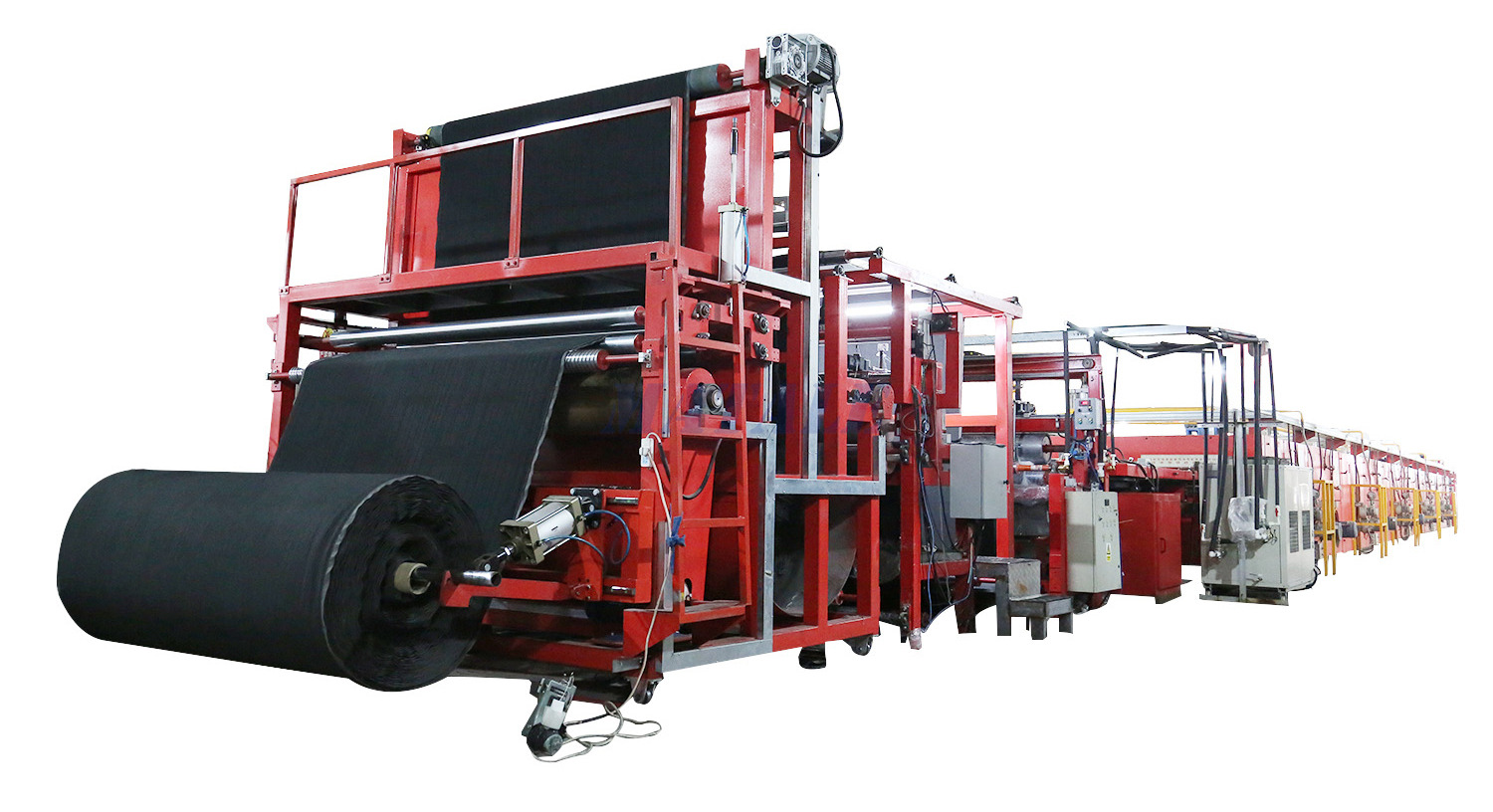
Understanding a carpet coating line requires examining its individual operational zones. Each mechanical module plays a highly vital role in maintaining continuous production.
Uniform web tension actively prevents structural distortion during processing. Carpets must enter the coating phase perfectly aligned and flat.
Accumulators: J-boxes or scray systems allow continuous operation during roll changes. They hold large reserves of fabric to prevent complete line stops. This keeps the ovens running at optimal temperatures.
Correction Rollers: Edge-guiding mechanisms correct lateral alignment dynamically. Bow and skew rollers ensure the textile web remains flat. They apply uniform tension across the entire width.
This critical module applies the chemical compound directly. It requires exact mechanical control and deep rheological understanding.
Lick Rollers vs. Scraper Blades: You must evaluate the application method based on pile height. Specific yarn twist levels and latex viscosity also dictate this choice. Each method interacts differently across various textile structures.
Penetration Control: Operators must manage roller pressure and application angles carefully. The compound must reach the tuft base completely. It should never bleed through to the visible carpet face.
Application Method | Best Suited For | Viscosity Range | Key Advantage |
|---|---|---|---|
Lick Roller System | Low to medium pile carpets | Low to medium viscosity | High-speed, highly uniform surface coating |
Scraper Blade System | High pile or very dense yarn | Medium to high viscosity | Forces heavy compound deeply into the tuft base |
The thermal zone removes residual moisture and fully cures the latex compound.
Multi-zone Ovens: Advanced impingement ovens provide precisely staged drying. They prevent surface blistering by gradually increasing heat zones. This ensures moisture escapes from the core safely.
Tenter Frames: Stenters firmly hold the tufted carpet backing at a precise predetermined width. This mechanical grip entirely prevents unwanted shrinkage during the intense thermal curing process.
The final mechanical stage prepares the cured carpet for storage or immediate shipment.
Cooling Zones: Chilled contact rollers stabilize the hot carpet before winding. Hot latex can stick disastrously if rolled immediately. Bringing the material below its glass transition temperature remains essential.
Winding Systems: Automated cross-cutting and winding systems enable completely seamless roll changeovers. They maintain vital production momentum and reduce manual labor dependency.
Procuring a carpet finishing machine involves strict technical diligence. You must map mechanical features directly to your desired operational outcomes.
Manual system adjustments cause frequent inconsistencies and massive material waste. Look for PLC-driven automated dispensing systems instead. These smart modules adjust roller gaps and drive speeds automatically. They rely entirely on saved digital recipes for specific product SKUs. Automated recipe management drastically reduces human operator error during complex changeovers. It ensures your first meter matches your last meter perfectly.
Evaluate the direct correlation between physical oven length and total heating capacity. A shorter oven configuration might save valuable factory floor space. However, it will inevitably bottleneck your maximum production speeds. You must slow the drive line down to achieve proper chemical curing. Plant managers must balance available footprint against required Overall Equipment Effectiveness (OEE). Calculating dwell time precisely prevents under-cured product shipments.
Global market demands change rapidly and unpredictably. Can you retrofit the pre-coating line easily in the future? You may need a secondary backing applicator later on. Systems adding action-bac, unitary, or specialized foam backing require inherent modularity. Mechanical scalability is highly critical for adapting your product portfolio. Buying a rigid, closed-loop system severely limits future revenue streams.
Installing large-scale textile machinery brings immense logistical challenges. We must address common pitfalls transparently to ensure smooth deployment.
A full continuous line requires extensive linear floor space. Buyers must map accumulators, ovens, and cooling zones accurately. You have to fit these massive modules among existing structural columns. Workflow paths for forklifts and raw materials must remain totally clear. You also need sufficient vertical clearance for exhaust ductwork. Careful spatial planning prevents incredibly costly installation delays.
Curing industrial latex compounds releases volatile organic compounds (VOCs). The intense thermal process also generates massive amounts of steam. Implementing this machinery requires highly robust exhaust handling systems. You will likely need industrial air scrubbers or regenerative thermal oxidizers. Compliance with strict local environmental emission regulations is absolutely mandatory. Ignoring this specific risk brings heavy operational fines and forced shutdowns.
Latex chemical buildup is practically inevitable during daily operation. You must carefully evaluate the machine's overall design for physical accessibility. Slide-out rollers make daily cleaning much faster and safer. Easily removable catch pans capture excess chemical runoff effectively. Integrated automated wash-down systems drastically reduce shift-change downtime. Prioritize equipment cleanability to maximize your total available operational hours.
Selecting the right equipment manufacturing partner requires a highly systematic approach. Follow these structured steps during your initial procurement phase.
Demand Proof of Concept: Shortlist specialized vendors offering full pilot line testing. Use your specific greige goods and unique latex compounds. Verify actual penetration depth and precise coat weights before buying.
Assess Long-Term Value Over Initial CapEx: Cheaper steel structures degrade quickly under heavy tension. Low-tier insulation in curing ovens wastes millions in thermal energy over a ten-year lifecycle. Invest in superior build quality and advanced insulation upfront.
Evaluate Spare Parts and Service Proximity: Carpet finishing runs continuously in most profitable plants. Sudden mechanical downtime proves financially catastrophic. Evaluate the vendor's local technician presence and response times. Demand globally standardized components like Siemens or Allen-Bradley PLCs. Avoid proprietary black-box hardware entirely to ensure simple maintenance.
Procuring finishing equipment is a highly complex engineering decision. It binds your entire production capacity to specific energy profiles. It also sets your raw material consumption rates for decades. Shift your evaluation away from basic maximum speed claims. Focus strictly on precise tension control and superior latex application efficiency. Prioritize highly modular oven design and standardized PLC architectures. This strict approach secures machinery capable of protecting your tight margins. It also guarantees consistent product quality across every batch. Start by completely auditing your current thermal energy costs today. Define your maximum acceptable coat-weight variance before proceeding further. Then, request detailed technical schematics and pilot testing from your shortlisted vendors.
A: A pre-coating line applies the initial adhesive directly to the back of tufted greige goods. This usually involves latex to lock the delicate yarns firmly in place. A secondary backing line applies an additional structural layer over that cured pre-coat. This distinct layer might be jute, synthetic woven material, or thick foam. Secondary backing adds substantial weight and ultimate dimensional stability.
A: Line speeds vary heavily based on specific oven capacity and total carpet weight. However, industrial continuous lines typically operate between 5 to 30 meters per minute. The primary physical bottleneck is usually the curing time required in the thermal oven. Mechanical drive systems can run much faster, but drying physics limit actual output.
A: Yes. Modern lines use highly adjustable digital tension controls. They feature variable lick-roll speeds and complex programmable recipes. Operators can easily switch between cut pile, loop pile, and varying face weights. The automated controls adjust physical application pressure intelligently. This prevents any physical damage to the delicate yarn structure during processing.
A: Most commercial-scale ovens utilize natural gas for direct or indirect firing. Some specific manufacturing plants use closed thermal oil systems instead. Advanced electric infrared (IR) pre-heating modules also exist for specialized applications. The optimal choice depends entirely on regional utility costs and your facility's existing power infrastructure.