- All
- Product Name
- Product Keyword
- Product Model
- Product Summary
- Product Description
- Multi Field Search


Views: 0 Author: Site Editor Publish Time: 2026-07-02 Origin: Site


Facility managers and textile manufacturers face a constant, difficult balancing act on the factory floor. You must maintain high-volume carpet production efficiency to meet tight commercial deadlines. However, the growing market demand increasingly favors intricate, customized designs that standard machines simply struggle to produce. We recognize this fundamental baseline: both traditional and modern machines produce highly durable loop pile carpets. Yet, they serve entirely different production tiers, customer demographics, and market segments. Choosing the wrong equipment can severely restrict your competitive edge and limit your catalog.
This comprehensive guide offers an objective, bottom-of-the-funnel comparison between standard and advanced tufting systems. We will deeply evaluate their mechanical complexities, maximum production outputs, and strategic advantages. By unpacking these operational differences, we help you make highly informed procurement decisions tailored exactly to your factory floor. Whether you aim to supply sprawling airport terminals or boutique luxury hotels, understanding the fundamental mechanics behind these systems ensures your next equipment investment drives tangible business growth.
Plain loop tufting machines excel in high-speed, high-volume production of solid-color or simple-texture carpets, offering the lowest cost-per-square-meter and easiest maintenance.
A graphic loop tufting machine utilizes advanced yarn feed controls and shifting needle bars to achieve high-definition, multi-color carpet pattern tufting, capturing premium market segments.
The transition from plain to graphic loop requires a significantly higher initial CapEx and introduces specialized software and maintenance training requirements.
Selecting the right machine depends on a factory's target clientele: standard contract/commercial flooring vs. bespoke, high-end hospitality and residential markets.
Textile machinery design always follows its intended output. We see this principle clearly when comparing basic and advanced tufting systems. Mechanical architecture directly dictates what a factory can and cannot produce.
The mechanics of standard models prioritize absolute reliability over structural complexity. These machines rely heavily on standard eccentric drives. They feature fixed needle bars striking the backing material in a rigid, unchanging sequence. Their uniform yarn feed systems push identical amounts of fiber through the needles during every single stroke.
Engineers build these systems for continuous, uninterrupted operation. They minimize moving electronic components to reduce wear and tear. You get fewer breakdowns and longer intervals between major maintenance cycles. As a result, the machine produces consistent, level loop textures efficiently. The rigid mechanical structure ensures every loop stands exactly at the designated height, creating a highly uniform surface ideal for large commercial spaces.
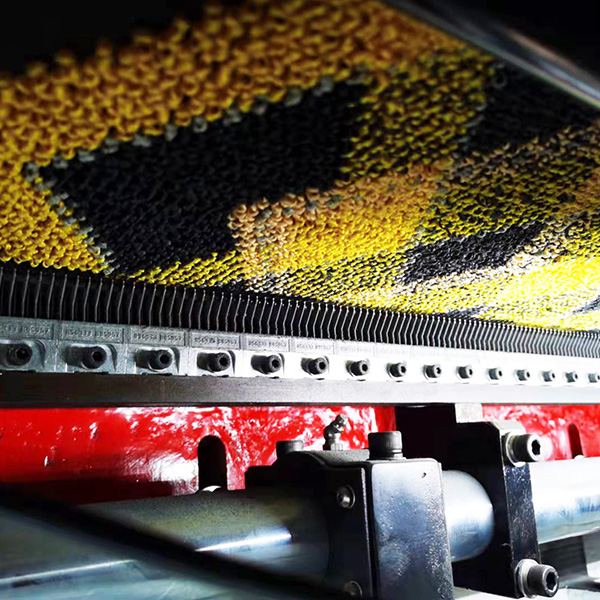
Advanced setups take a radically different approach to textile manufacturing. A graphic loop tufting machine integrates highly complex, servo-motor-driven yarn feed rollers. These often include scroll, crossover, or individually controlled yarn systems. Rather than feeding yarn uniformly, servo motors adjust the tension and feed rate for every single needle group in real time.
Furthermore, these modern models utilize sliding or shifting needle bars. Depending on the specific build, they might feature single or double shifting configurations. These bars move laterally across the backing cloth. They cross yarns over one another to build complex geometric or organic designs. Because of this mechanical complexity, they rely heavily on specialized CAD pattern software. This software interfaces directly with the machine's electronic control systems, translating digital pixels into precise servo movements instantly.
Understanding the difference in throughput and design flexibility helps you accurately project factory revenue.
We must analyze the throughput speeds to understand true factory floor capabilities. A plain loop tufting machine operates at significantly higher RPMs. It pushes needles through the primary backing at blistering speeds, sometimes exceeding 1000 RPM depending on the gauge. This makes it ideal for fulfilling massive commercial broadloom orders. It handles standard carpet tile runs perfectly when you face demanding delivery deadlines.
In contrast, we must assess the operational speeds of advanced models differently. You will notice a slight reduction in overall RPM, often hovering between 600 and 800 RPM. This slowdown occurs due to the strict mechanical requirements of needle shifting and variable yarn feeding. The servos need micro-seconds to adjust tension accurately. The needle bars need time to slide laterally without tearing the primary backing cloth.
When producing basic carpets, design limitations become immediately apparent. Plain setups mostly rely on space-dyed yarn to create visual variety. You cannot alter the physical structure of the pile dynamically. The machine simply loops whatever color yarn you thread into the creel.
Modern systems break these creative boundaries completely. They execute precise carpet pattern tufting with incredible accuracy. You can program varying loop heights to create rich, three-dimensional textures. The lateral needle shifting allows seamless multi-color integration directly into the substrate. You achieve vibrant, complex imagery without requiring expensive, secondary post-tufting printing processes. This opens the door to sculptured effects and high-low loop texturing.
Despite their technical differences, both systems share a fundamental core. Every commercial-grade loop pile carpet machine produces robust, crush-resistant structures. These loops withstand heavy foot traffic beautifully. They suit demanding environments like airport terminals, schools, and corporate hallways. However, the graphic output naturally commands a much higher retail premium due to its bespoke, structural aesthetic.
Upgrading your factory floor introduces specific operational realities. You must prepare your management team and your technical crew for new workflows.
Running a standard machine requires basic mechanical training. Operators learn how to thread the creel efficiently, mend broken yarns, and monitor the eccentric drives. They make manual wrench adjustments to alter pile heights. The learning curve remains relatively short and straightforward.
Conversely, running advanced machinery demands entirely new digital skill sets. Operators must understand digital pattern processing. They must learn how to adjust tension parameters for variable feed rollers via digital HMI touchscreens. Software troubleshooting becomes just as important as mechanical wrenching. You will likely need to upskill your current workforce or hire dedicated technical personnel to manage these complex interfaces.
Production scheduling changes dramatically depending on your equipment type.
Standard Changeovers: Plain machines require minimal adjustment between runs. You might change the yarn colors on the creel, but the machine settings remain largely untouched. You keep factory downtime to an absolute minimum, ensuring high daily yields.
Complex Changeovers: Graphic machines face much longer changeovers. When you thread complex new patterns, operators must ensure perfect alignment across hundreds of needles. They must calibrate the shifting bars and verify the software files. You demand strict production scheduling to prevent unprofitable downtime. Running short, custom orders requires precise planning to maintain overall factory efficiency.
Mechanical upkeep differs wildly between the two systems. Standard models need regular lubrication, eccentric drive checks, and basic part replacements. Your in-house mechanics can usually handle everything without outside assistance.
Advanced models address the necessity of specialized technicians. A simple software glitch can halt production entirely. Servo synchronization issues require precise electronic calibration. If a shifting mechanism falls out of alignment, it can destroy the backing material or snap hundreds of needles instantly.
Best Practice: Always maintain a direct support contract with the machine manufacturer. Keep spare electronic components on hand to avoid lengthy shipping delays.
Common Mistake: Treating a servo-driven machine like a purely mechanical one. Ignoring software updates or bypassing electronic diagnostics will inevitably lead to catastrophic production failures.
Production Variable | Plain Setup | Graphic Setup |
|---|---|---|
Primary Mechanism | Fixed needle bar, uniform yarn feed | Shifting needle bar, variable servo feed |
Operating Speed (RPM) | Very High (Maximized for sheer output) | Moderate to High (Paced for shifting accuracy) |
Design Capability | Solid colors, simple uniform textures | Intricate geometric and organic multi-color designs |
Changeover Time | Short (Mechanical adjustments only) | Long (Software calibration, complex threading) |
Maintenance Complexity | Low (Standard mechanical upkeep) | High (Electronic servo calibration, software debugging) |
Choosing the right equipment determines your future market positioning. You must rigorously analyze your current client base before signing a purchase order.
This traditional system remains the backbone of global commercial flooring. You should choose this path under specific business conditions.
Your primary contracts target standard commercial, institutional, or basic residential carpets. These clients prioritize extreme durability and aggressive pricing over bespoke aesthetics.
Maximum yield and machine uptime represent the core Key Performance Indicators (KPIs) of your facility. You win business through massive volume and rapid delivery times.
You lack the technical infrastructure to support advanced electronic maintenance. If your factory floor operates far from specialized tech hubs, simpler machinery ensures continuous, reliable operation.
Advanced systems unlock entirely new revenue streams. You should pursue this technology if your strategic goals align with luxury markets.
You actively target the hospitality sector, high-end corporate interiors, or the custom area rug market. These buyers demand unique visuals and gladly pay premium prices for exclusivity.
Your business strategy relies heavily on product differentiation. You want to offer built-in structural designs rather than relying on secondary post-dyeing or printing processes.
You possess the operational strategy to absorb slightly slower run rates. You fully understand that lower volume output gets offset by massive pricing power in the luxury market segment.
The choice between these manufacturing technologies is rarely about which machine is objectively better. Instead, the decision hinges on which system perfectly aligns with your target market and operational maturity. Plain systems dominate the high-volume, standard commercial flooring space by maximizing yield and minimizing downtime. Advanced systems unlock the highly lucrative, bespoke design sector by offering unparalleled structural creativity.
We strongly advise buyers to conduct a full, rigorous audit of their current maintenance capabilities and client demand before committing to a machine type. Evaluate your available floor space, your maintenance crew's technical skill level, and your local yarn supply chains. To take the next step, request detailed technical specification sheets from reputable manufacturers. Schedule a thorough production consultation with their engineers, and map out your projected profit margins based on your specific target market pricing.
A: Retrofitting standard machines poses significant engineering challenges. While basic attachments exist to introduce minor yarn tension variations, achieving true high-definition graphics remains nearly impossible. High-end designs require complex servo motors, specialized shifting needle bars, and proprietary software interfaces. Achieving these capabilities usually requires a purpose-built frame and integrated control system straight from the factory.
A: These machines rely on specialized CAD/CAM tufting software provided or approved by the manufacturer. Designers create pixel-based patterns, which the software translates into exact servo commands for yarn feed and needle shifting. You must ensure seamless compatibility between your internal design department's drafting tools and the machine's proprietary interface to avoid costly production errors.
A: Maintenance differs heavily in scope and frequency. Standard machines require routine mechanical lubrication, eccentric drive checks, and needle replacements. Advanced models demand those same mechanical checks, plus frequent electronic calibrations. You must regularly lubricate the precise shifting-mechanisms and update control software. Ignoring the electronic maintenance on advanced models will quickly lead to severe pattern distortion.