- All
- Product Name
- Product Keyword
- Product Model
- Product Summary
- Product Description
- Multi Field Search


Views: 0 Author: Site Editor Publish Time: 2026-07-14 Origin: Site


Post-installation failures in modular flooring—specifically curling, doming, and gapping—are rarely installation errors; they are manufacturing defects rooted in thermal mismanagement during the coating process. Manufacturers often focus on backing chemistry (PVC, bitumen, polyolefin) to ensure product durability. However, if the thermal history of the tile is ignored, residual internal stresses will inevitably cause the tile to deform when exposed to ambient temperature fluctuations. The critical variable in preventing these defects is the cooling phase. Evaluating the thermal control capabilities of a Carpet Tile Coating Machine is the most decisive step in ensuring compliance with strict dimensional stability standards (like EN ISO 23999) and protecting your brand from costly warranty claims.
Cooling Rate Dictates Internal Stress: Rapid or uneven cooling "freezes" polymer chains before they can relax, leading to latent internal stress that releases post-installation as shrinkage or curling.
Top vs. Bottom Differentials: A high-performance carpet tile coating machine must manage the temperature delta between the face yarn and the backing material to prevent bi-metallic strip-style warping.
Environmental Triggers: Ambient stressors like underfloor heating, direct sunlight, and hydration/dehydration cycles accelerate the release of built-in manufacturing stresses, leading to peaking or gapping at the joints.
Equipment Evaluation Focus: When assessing a modular carpet backing line, prioritize zone-based temperature control, chilled roller precision, and tensionless web handling over raw line speed.
Throughput vs. Quality Trade-off: Accelerating line speed without proportionally extending the cooling zone directly degrades the dimensional stability of the finished tile.
Dimensional stability defines the degree to which a carpet tile maintains its original length, width, and flatness when subjected to temperature and humidity variations. We quantify this metric as the percentage of dimensional change relative to the original size of an unrestrained sample. Passing strict international standards requires precise control over the entire manufacturing lifecycle. When a tile fails to maintain its shape, the entire flooring installation degrades. Gaps emerge between seams. Edges lift and create trip hazards. Defining this success criteria early helps production teams understand why thermal control matters more than raw output volume. You must measure stability in both the machine direction (MD) and cross-machine direction (CMD). Variations between these two axes indicate uneven tension or cooling across the web width.
Testing protocols typically involve placing a conditioned tile in an oven at 60 degrees Celsius for a specified duration, usually two to twenty-four hours. Technicians then measure the tile after it cools back to room temperature. Any deviation from the initial measurements represents a failure in the manufacturing process. A stable tile will show less than a 0.2% dimensional change. Anything higher points directly to unresolved internal stresses locked into the backing during production.
Backing compounds expand significantly when heated during the extrusion or coating process. Heat activates the polymer chains, allowing them to flow and bond with the primary backing and fiberglass reinforcement layers. You must control the contraction during the cooling phase to prevent permanent, locked-in deformation. As the compound cools, polymer chains attempt to return to their resting state. If the material cools too fast, these chains freeze in an elongated, stressed position. This locked-in tension remains dormant until external heat reactivates the polymer post-installation.
Different backing materials exhibit distinct thermal behaviors. PVC requires high processing temperatures to achieve proper plastisol fusion, meaning it undergoes a massive thermal drop during cooling. Bitumen compounds process at lower temperatures but hold heat longer due to their dense, viscous nature. Polyolefin backings have a sharp melting point and require highly calibrated cooling to prevent sudden crystallization. Understanding these specific polymer behaviors allows operators to adjust the cooling curve accurately.
Uneven cooling leads directly to specific, predictable field defects. Understanding these mechanics helps operators diagnose machinery faults based on customer complaints. We see three primary failure modes in the field.
Cold Temperatures & Dehydration: These conditions cause the backing material to contract. This contraction leads to joint gapping across the installation. It compromises structural integrity and creates unwanted acoustic and thermal bridges between the subfloor and the interior space.
Hot Temperatures & Hydration: Elevated temperatures and moisture cause expansion. The tile pushes against adjacent squares, leading to joint peaking. Severe expansion causes buckling and vertical edge curling, destroying the visual and functional quality of the floor.
Asymmetrical Moisture Absorption: When the face yarn absorbs ambient humidity while the impermeable backing remains dry, the top layer expands. This differential expansion forces the tile edges downward, creating a doming effect in the center of the tile.
Post-installation environments act as thermal catalysts that prematurely trigger the release of latent manufacturing stresses. Direct solar exposure through large architectural windows heats specific floor sections rapidly. Surface temperatures in direct sunlight can easily exceed 50 degrees Celsius. Modern underfloor heating (UFH) systems apply continuous, radiant heat directly to the backing. These environmental factors do not break a stable tile. Instead, they expose the hidden thermal history of a poorly manufactured product. A stable tile withstands these catalysts. A stressed tile deforms almost immediately.
Facility managers often blame the installation contractor or the adhesive when tiles fail over UFH systems. However, pressure-sensitive adhesives cannot hold down a tile that possesses severe internal curling forces. The mechanical stress of the warping polymer easily overcomes the chemical bond of the tackifier. The root cause always traces back to the factory floor and the cooling parameters used during production.
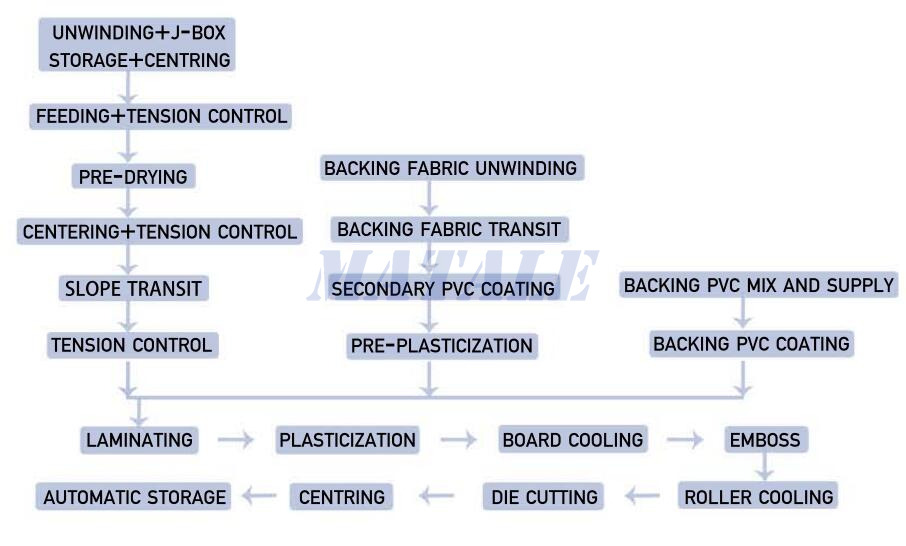
Aggressive cooling introduces severe risks to the final product. Dropping the temperature too quickly causes the outer layer of the backing to solidify instantly. Meanwhile, the core remains molten. This differential cooling traps severe internal tension within the backing matrix. We call this rapid quenching. Quenching might allow faster line speeds, but it guarantees product failure. The trapped tension acts like a coiled spring. When the tile eventually encounters ambient heat in a commercial office, the spring releases. The result is catastrophic shrinkage and buckling across the entire installation footprint.
Operators sometimes increase the chilled water flow to maximum capacity to compensate for a shortened cooling zone. This practice shocks the polymer. The surface skin hardens and shrinks, compressing the still-warm internal layers. As the core eventually cools and attempts to shrink, the hardened outer skin restricts it. This internal battle between layers creates a permanent mechanical imbalance. You cannot fix this imbalance after the tile leaves the line.
A stepped, gradual cooling rate allows polymer chains to relax naturally. We refer to this process as annealing. Annealing brings the compound down to its glass transition temperature slowly. It prevents the outer skin from hardening before the core stabilizes. This gradual reduction results in a structurally stable, stress-free tile. Implementing a proper annealing curve requires a sophisticated modular carpet backing line capable of precise thermal modulation. The extra time spent in the cooling zone pays dividends by eliminating warranty claims and protecting brand reputation.
An effective annealing process requires multiple temperature zones. The first zone might drop the web temperature by 20 degrees, the second by 15 degrees, and the final zone brings it down to ambient room temperature. This stepped approach gives the polymer chains the necessary time to untangle and settle into a relaxed configuration. You must monitor the web temperature continuously between each zone to verify the cooling curve matches the target profile.
Cooling a heavy backing without over-chilling or trapping heat in the face fiber presents a complex engineering challenge. We must manage the Z-axis thermal gradient carefully. The face yarn and the backing material possess entirely different thermal mass and conductivity properties. An unbalanced gradient causes the face and backing to contract at different rates. This differential acts exactly like a bi-metallic strip in a thermostat. If the backing shrinks more than the face, the tile curls upward. If the face shrinks more, the tile domes. Controlling this gradient guarantees structural flatness.
You achieve Z-axis control by applying different cooling methods to the top and bottom of the web. Chilled rollers extract heat from the bottom backing layer through direct contact. Simultaneously, ambient or slightly cooled air blows across the face yarn to extract heat from the top. Balancing the roller temperature with the air velocity ensures the entire cross-section of the carpet cools at a uniform rate. Operators must adjust these settings based on the specific pile height and backing thickness of the current production run.
Evaluating the primary cooling mechanisms helps determine the right equipment for your specific backing chemistry. We generally compare chilled rollers and forced air systems. Each method offers distinct advantages depending on the material thermal mass.
Cooling Mechanism | Heat Transfer Method | Best Application | Key Advantage |
|---|---|---|---|
Chilled Water Rollers | Direct Conductive | Heavy PVC, Bitumen | Rapid, controlled heat extraction from the bottom up. |
Forced Air Systems | Convective | Lighter weights, Face Yarn | Evens out top-surface temperatures without contact. |
Hybrid Systems | Conductive & Convective | High-Speed Production | Balances the Z-axis gradient perfectly across all layers. |
Water Bath Quenching | Direct Immersion | Specific Polyolefins | Instant surface sealing (requires careful core management). |
Heavy-weight polymer and bitumen backings necessitate hybrid approaches. Relying solely on one method usually results in uneven thermal profiles. Chilled rollers must feature internal baffling to ensure uniform water flow and consistent surface temperatures across the entire face width. A roller with dead spots will create longitudinal bands of stressed material in the finished web.
Modern equipment must meet strict standards for thermal precision. A reliable machine offers multiple, independently controlled cooling zones. This setup establishes an optimized, downward thermal gradient rather than a single, drastic temperature drop. Zone-based control allows operators to fine-tune the cooling curve based on the specific compound weight and ambient factory conditions. You can drop the temperature by specific increments across each successive zone. This precision prevents thermal shock and ensures the backing cures uniformly from edge to edge.
Each zone requires its own dedicated temperature sensors, water circulation pumps, and heat exchangers. If you link all cooling rollers to a single chiller circuit, you lose the ability to profile the cooling curve. The first roller will absorb the majority of the heat, leaving the subsequent rollers too cold. Independent circuits allow you to set the first roller at 40 degrees Celsius, the second at 30 degrees, and the final roller at 15 degrees, creating a perfect annealing environment.
Web tension during the cooling phase represents a critical evaluation dimension. As the backing cools, the physical material contracts. The web tension must dynamically adjust to accommodate this shrinkage. Excessive mechanical tension during cooling stretches the warm, pliable backing. If you pull the material too hard while it cools, you lock in that stretched state. Once the tile is cut and boxed, it will inevitably attempt to shrink back to its natural length. Tensionless web handling systems utilize advanced sensors and variable speed drives to maintain zero-stress transport through the cooling tunnel.
Load cells and dancer rollers provide the necessary feedback to the drive motors. As the material shrinks, the dancer roller shifts position. The control system detects this movement and slightly reduces the speed of the downstream drive, allowing the web to contract naturally without stretching. You must calibrate these tension systems specifically for the elasticity of the backing compound. A rigid bitumen backing requires different tension parameters than a highly flexible PVC plastisol.
Operational reality dictates a strict trade-off between throughput and stability. Increasing meters-per-minute requires a mathematically proportional increase in cooling capacity. You cannot simply speed up the drive motors. The polymer must reach its safe glass transition temperature before it hits the winding or die-cutting stations. Pushing a carpet tile production line past its thermal capacity limits guarantees defective output. Operators must calculate the exact dwell time required for their specific backing weight and ensure the cooling zone length supports the target line speed.
If your current cooling zone measures 10 meters and allows a safe production speed of 5 meters per minute, doubling your speed to 10 meters per minute requires extending the cooling zone to 20 meters. Attempting to run at 10 meters per minute on the original 10-meter zone cuts the dwell time in half. The material will exit the cooling section while still warm and pliable. The subsequent cutting process will induce massive mechanical stress into the unstable tiles.
A longer, gradual cooling process requires a larger physical footprint for the production line. Facility constraints often complicate equipment upgrades. You must evaluate creative engineering solutions to maximize cooling time within limited floor space. Accumulator towers allow the web to travel vertically, increasing dwell time without extending the linear footprint. Multi-tier cooling racks and overhead cooling conveyors utilize vertical factory space effectively. Planning the layout requires careful consideration of material flow and maintenance access around these extended cooling structures.
When designing vertical cooling accumulators, you must account for the weight of the coated web. Heavy bitumen backings place immense strain on the upper guide rollers. You need robust structural supports and large-diameter rollers to prevent the web from creasing or cracking as it navigates the vertical turns. Additionally, hot air rises. The upper tiers of a vertical accumulator will naturally be warmer than the lower tiers. You must install adequate ventilation and extraction fans to remove this trapped heat and maintain a consistent cooling environment.
Extended cooling zones introduce hidden operational costs. You must evaluate the efficiency of the industrial chillers required to supply the cooling rollers. Focus on closed-loop systems that minimize water waste. Assess thermal recovery options that capture extracted heat for use in other factory processes. Ambient temperature variables in your facility will impact chiller performance. Sizing the chillers correctly ensures they can maintain the required water temperatures even during peak summer production months. Undersized chillers will bottleneck your entire production line.
Calculate the required chiller capacity based on the maximum coating weight, the specific heat capacity of the backing compound, and the target line speed. A line producing 5-kilogram-per-square-meter bitumen tiles at 10 meters per minute requires significantly more cooling tonnage than a line producing 3-kilogram PVC tiles at the same speed. Always build a 20% safety margin into your chiller sizing calculations to account for efficiency losses over time and extreme ambient weather conditions.
Establish a clear benchmark for success before upgrading equipment. Ensure the production line can consistently produce tiles that pass international standards like EN ISO 23999. This standard measures dimensional stability as the percentage change from the original size. It also measures curling as vertical deformation in millimeters. Testing involves accelerated heat aging, typically exposing unrestrained samples to 60 degrees Celsius. If the tile deforms beyond the allowable tolerances after this exposure, the cooling process failed. Make this standard a non-negotiable performance metric for any new machinery.
Require the equipment manufacturer to guarantee EN ISO 23999 compliance in writing as part of the purchase contract. Specify the exact backing formulations and coating weights you intend to run. The manufacturer should provide empirical data demonstrating their cooling section design can meet these tolerances at your target production speeds. Do not accept theoretical calculations; demand physical test results from similar installations.
Go beyond basic laboratory standards. Prioritize equipment lines validated by rigorous simulated environmental testing protocols. Subject unrestrained sample tiles to simulated underfloor heating cycles. Expose them to extreme humidity and dehydration shifts in environmental chambers. These tests replicate the harshest field conditions. If the tiles remain flat and dimensionally stable through these cycles, you can trust the thermal management capabilities of the coating line. This empirical data provides confidence in the equipment investment.
Set up a testing chamber that cycles between 10 degrees Celsius at 20% relative humidity and 40 degrees Celsius at 80% relative humidity. Run the samples through fifty continuous cycles. Measure the tiles at the end of the test. A properly annealed tile will show zero permanent deformation. A tile with locked-in manufacturing stress will exhibit severe edge curling or doming after enduring these extreme environmental swings.
Provide a strict framework for buyer due diligence. Do not accept marketing claims regarding cooling efficiency. Demand hard data from the original equipment manufacturer (OEM). Request thermal imaging data showing the heat distribution across the web as it exits the cooling zone. Ask for continuous temperature monitoring logs from trial runs. Review tension-sensor readouts to prove cooling uniformity and tensionless handling across the entire web width. A reputable vendor will gladly provide this proof of concept to validate their engineering.
Schedule a Factory Acceptance Test (FAT) at the vendor facility before authorizing shipment. Bring your own backing compound and face yarn to the test. Run the line at full production speed. Take thermal camera readings of the web as it passes over each cooling roller. Verify the temperature drops match the engineered cooling curve. Cut sample tiles immediately off the line and subject them to rapid heat aging tests on-site. If the tiles fail, halt the shipment until the vendor resolves the cooling deficiencies.
Assess the compatibility of advanced cooling modules with your existing infrastructure. Many facilities want to upgrade their cooling capacity without replacing legacy bitumen, polyurethane, or PVC extrusion heads. Ensure the new cooling section interfaces seamlessly with the current control systems. Evaluate the mechanical transition points to prevent web distortion as the material moves from the older coating head into the modern cooling tunnel. Proper integration maximizes the return on investment while solving the core dimensional stability issues.
Pay close attention to the drive synchronization between the old and new equipment. The legacy coating head likely uses older motor control technology. The new cooling section will feature modern servo drives. You must install a master control PLC that can communicate with both systems and maintain perfect speed matching. Even a 1% speed differential between the coating head and the cooling section will induce massive tension spikes, completely negating the benefits of the new annealing zones.
The dimensional stability of a carpet tile is ultimately finalized in the cooling zone. Overlooking cooling rate precision in favor of raw production speed is a false economy that leads to systemic product failure and costly claims. When evaluating a carpet tile coating machine, prioritize vendors that offer modular, multi-zone cooling systems with integrated, automated tension control. To ensure your next equipment upgrade eliminates warping and gapping defects, take the following actions:
Request detailed technical schematics of the cooling section from shortlisted manufacturers to verify independent zone control.
Ask vendors for the maximum allowable line speed that still guarantees EN ISO 23999 compliance for your specific backing weight.
Demand thermal imaging trial data to verify Z-axis gradient control across the entire web width.
Evaluate your current facility footprint to determine if vertical accumulators are necessary for extended cooling dwell times.
Calculate your required chiller capacity, including a 20% safety margin for peak summer ambient temperatures.
A: Dimensional stability refers to a carpet tile's ability to retain its original dimensions and remain flat when exposed to changes in temperature and moisture. Under standards like EN ISO 23999, it is calculated as the percentage of dimensional change in length and width compared to the tile's original size after undergoing heat aging.
A: If the backing is cooled too rapidly (quenched), it traps high internal stresses within the polymer structure. When the tile is later exposed to ambient heat post-installation, these stresses release, causing the tile to shrink, swell, or curl.
A: Underfloor heating and direct sunlight act as thermal triggers. If a carpet tile coating machine failed to properly anneal the backing during production, these external heat sources cause the material to expand or release built-in stresses, leading to peaking at the joints and vertical buckling.
A: In addition to temperature shifts, changes in relative humidity cause textile fibers to expand (hydration) or contract (dehydration). If the backing thermal history is unstable, these cycles compound the physical stress, accelerating edge curling and joint gapping.
A: The length of the cooling zone depends on the backing material (PVC, bitumen, polyolefin), the coating weight, and the target line speed. It must be long enough to allow gradual temperature reduction without shocking the material, often requiring multi-zone cooling tunnels or multi-tier conveyor layouts to save floor space.
A: No. While precise temperature and tension control during cooling can prevent stress-induced deformation, it cannot compensate for fundamentally unstable chemical formulations or incorrect filler-to-polymer ratios in the backing compound.