- All
- Product Name
- Product Keyword
- Product Model
- Product Summary
- Product Description
- Multi Field Search


Views: 0 Author: Site Editor Publish Time: 2026-07-11 Origin: Site


Rushing carpet manufacturing carries hidden financial and reputational costs, often leading to premature product failure. When consumers experience flaking backings within the first 15 months of installation, the root cause usually points back to the production floor. Manufacturers constantly face the tension between maximizing production throughput and ensuring adequate chemical cross-linking of carpet backing compounds. This delicate balance dictates the final product's durability and structural integrity.
Mitigating curing defects requires a deep evaluation of production infrastructure. Achieving the precise thermal control necessary for optimal compound curing is impossible with outdated equipment. Upgrading to a modern, thermally precise carpet coating machine provides the control needed to maintain high line speeds without compromising the chemical integrity of the backing.
Insufficient curing time directly correlates with catastrophic carpet failures, including delamination, reduced tuft bind strength, and increased susceptibility to moisture and microbial damage.
The distinction between "drying" (evaporating water) and "curing" (chemical cross-linking of polymers) is the primary driver of long-term carpet durability.
Over-curing is as hazardous as under-curing; prolonged heat exposure past the optimal window degrades polymer backing chains, leading to brittle backing and low bond strength.
Modernizing a latex carpet coating line allows manufacturers to increase line speeds without sacrificing the mandatory dwell time and thermal consistency required for optimal curing.
Evaluating a new carpet coating machine requires analyzing zoned temperature controls, airflow dynamics, and tension management to ensure consistent application and curing.
Drying and curing are distinct processes in carpet manufacturing. Drying involves the simple removal of water from the applied compound through evaporation. Curing, however, requires the chemical polymerization or cross-linking of latex or polyurethane compounds. This chemical reaction forms the strong, durable network that binds the carpet components together.
Achieving maximum bond strength in carpet backing compounds requires specific chemical conditions. The polymers must reach a state where they interlock, creating a resilient structure. If the process stops at mere drying, the backing remains weak and susceptible to mechanical failure under stress. We often see operators confuse a dry surface with a cured compound, leading to massive quality control issues down the line.
Process Phase | Primary Action | Physical Result | Impact on Carpet Durability |
|---|---|---|---|
Drying | Water evaporation via heat | Compound becomes solid to the touch | Minimal structural strength; prone to failure |
Curing | Chemical cross-linking of polymers | Molecular bonds form a resilient network | Maximum tuft bind and delamination resistance |
Specific temperature thresholds must be maintained over an exact duration, known as dwell time, to activate curing agents properly. If the temperature is too low or the dwell time too short, the chemical cross-linking remains incomplete. A precise thermal profile ensures the compound cures uniformly throughout its thickness.
Ambient factory environment variables significantly impact the initial water evaporation rate in a latex carpet coating line. Seasonal humidity or humid coastal climates slow down evaporation, altering the required time-temperature profile. Industry-standard evaluation lenses emphasize the direct relationship between consistent thermal exposure and reliable adhesive performance.
Ambient Humidity: High moisture in the factory air slows the initial drying phase, requiring longer oven dwell times.
Compound Viscosity: Thicker latex applications demand a slower, graduated heat curve to prevent surface skinning.
Substrate Weight: Heavier primary backings absorb more heat, altering the thermal transfer rate to the chemical compound.
Airflow Velocity: Proper impingement airflow breaks the boundary layer of moisture on the carpet surface, accelerating evaporation.
Prolonged or excessive curing temperatures degrade polymer backing networks. When temperatures exceed the optimal chemical threshold, the polymer chains break down rather than strengthen. This thermal degradation ruins the structural integrity of the backing compound.
A backing that looks dry and feels "tack-free" can still possess significantly reduced bonding and peel strength. Over-exposure in the oven makes the compound brittle. Relying solely on surface appearance rather than precise thermal metrics leads to catastrophic product failures in the field. You must rely on internal temperature probes and strict recipe management, not just a visual check at the end of the line.
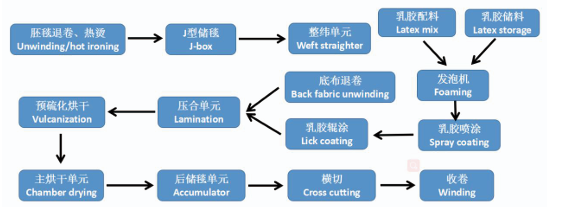
Secondary backing separation occurs when the adhesive layer fails to hold the primary and secondary backings together. Insufficient curing leaves the latex weak, preventing a strong mechanical bond. Real-world implementation failures often manifest as consumer complaints of carpet backings flaking off shortly after installation, sometimes within 12 to 15 months.
Under-cured latex is highly vulnerable to post-installation environmental factors. UV exposure, direct sunlight, and ambient humidity accelerate the disintegration of the weak compound. This rapid degradation turns what should be a durable floor covering into a brittle, failing mess. When you pull up a failed carpet and see white dust or flakes left behind, you are looking at the direct result of an inadequate thermal profile during manufacturing.
Inadequate curing leaves the primary backing and yarn loops vulnerable to pull-outs. Without a fully cross-linked adhesive network, the tufts lack the necessary anchor to withstand foot traffic. This leads to premature wear and a rapidly deteriorating appearance.
The impact on dimensional stability is equally severe. Carpets with under-cured backing lack structural rigidity, leading to buckling, stretching, and wrinkling. These issues plague both commercial and residential applications, resulting in costly replacements and damaged reputations. A carpet that stretches out of shape within six months of installation almost always suffered from poor tension control or insufficient heat during the backing process.
Trapped moisture from incomplete curing creates an ideal breeding ground for mold, mildew, and bacteria within the backing structure. The longer the moisture remains, the higher the risk of microbial proliferation. This compromises the hygiene and safety of the indoor environment.
Furthermore, under-cured chemical compounds can lead to prolonged off-gassing. Elevated Volatile Organic Compound (VOC) emissions result from incomplete polymerization. Carpets emitting high VOC levels fail indoor air quality and green building standards, limiting their market viability. Proper curing locks these chemicals into a stable polymer matrix, preventing them from escaping into the air.
The physical length of the curing oven dictates the maximum allowable line speed. A specific dwell time is mathematically required for the compound to reach full cure. If the line runs too fast for the oven length, the carpet exits under-cured.
Modern machines optimize this ratio to prevent bottlenecks without rushing the cure. By extending oven lengths or improving heat transfer efficiency, manufacturers can increase throughput safely. This ensures production targets are met without risking thermal over-exposure or under-curing. You cannot cheat physics; if your compound requires three minutes at 300 degrees Fahrenheit, your line speed must be calculated to keep the carpet in the heat zone for exactly that duration.
Oven Length (Meters) | Required Dwell Time (Minutes) | Maximum Safe Line Speed (Meters/Min) |
|---|---|---|
30 | 3.0 | 10.0 |
45 | 3.0 | 15.0 |
60 | 3.0 | 20.0 |
Multi-zone heating is necessary to gradually raise temperatures, preventing surface skinning. If the surface seals too quickly, moisture becomes trapped inside the compound, preventing a full cure. Gradual heating allows water to evaporate before the final cross-linking phase begins.
Specialized exhaust systems adapt to external relative humidity to ensure stable evaporation rates. High-efficiency exhaust and impingement airflow systems provide uniform heat distribution across the web. This prevents localized cold spots and ensures consistent curing across the entire width of the carpet. Without zoned control, the edges of the carpet might over-cure while the center remains wet.
A specialized tufted carpet backing machine maintains precise web tension to prevent distortion. During the thermal expansion and contraction phases of curing, improper tension causes bowing, skewing, or shrinking. Consistent tension management preserves the carpet's dimensional stability.
Accurate doctor blades and applicator rolls prevent uneven coating thickness. Thick spots require more time to cure, leading to localized under-curing if the line speed is set for the average thickness. Precision application ensures uniform thermal requirements across the entire product.
Load cells monitor web tension in real-time across the entire oven length.
Variable frequency drives (VFDs) adjust roller speeds instantly to compensate for thermal shrinkage.
Precision doctor blades maintain a coating tolerance of fractions of a millimeter.
Automated edge-guiding systems keep the carpet aligned, preventing uneven heat exposure on the selvedges.
Balancing production targets with quality assurance requires a clear decision framework. Increasing line speed must be matched with adequate thermal capacity to maintain curing standards. Manufacturers must evaluate equipment based on its ability to scale throughput without compromising the chemical integrity of the backing.
Machine features that allow for recipe-driven automation ensure different carpet weights and backing types receive exact curing profiles. Programmable logic controllers (PLCs) automate temperature and speed adjustments, reducing human error. This guarantees consistent quality across diverse product lines. When operators manually adjust settings based on guesswork, defect rates skyrocket.
The operational costs of curing ovens represent a significant portion of manufacturing expenses. Assessing these costs is crucial when evaluating new equipment. High energy consumption cuts into profit margins and reduces overall operational efficiency.
Features like heat recovery systems and advanced insulation maintain thermal consistency while reducing energy consumption per square yard. Efficient airflow design maximizes heat transfer to the carpet, minimizing wasted energy. These upgrades lower operational costs while improving curing reliability. Modern insulation materials prevent heat loss into the factory, keeping the energy focused entirely on the carpet web.
The right equipment ensures compliance with stringent industry durability tests, such as ASTM standards for tuft bind and delamination strength. Consistent curing profiles guarantee that every yard of carpet meets these rigorous benchmarks. This protects the manufacturer from costly claims and product recalls.
Integrated moisture and temperature sensors provide real-time quality control data. These sensors monitor the curing process continuously, allowing operators to make immediate adjustments. Real-time data prevents large batches of defective products from leaving the facility. If the exit moisture content spikes, the system can automatically slow the line speed to compensate.
Extending dwell time often requires longer ovens, presenting a challenge for facilities with limited floor space. The physical footprint of a new machine must be carefully planned to fit within existing building constraints. Ignoring space limitations leads to compromised equipment designs.
Mitigation strategies include multi-pass oven configurations or vertical curing accumulators. These designs maximize dwell time within a smaller horizontal footprint. Custom engineering solutions allow manufacturers to upgrade curing capacity without expanding their building. We frequently design double-pass systems for plants that are landlocked but need higher throughput.
Transitioning from legacy equipment to automated, PLC-controlled lines involves a significant learning curve. Operators must understand new interfaces and control logic. Inadequate training leads to operational errors and inconsistent product quality.
Vendor-supplied training and standardized recipe programming are essential. Comprehensive training programs ensure operators can utilize the new equipment effectively. Standardized recipes eliminate guesswork, ensuring consistent curing profiles for every product run. A machine is only as good as the operator running it, making hands-on training non-negotiable.
Integrating a new line into an existing facility requires careful planning to minimize production halts. Extended downtime disrupts supply chains and impacts revenue. A strategic approach is necessary to manage the transition smoothly.
A phased installation approach minimizes disruptions. Preparing the site and installing auxiliary systems before shutting down the main line reduces overall downtime. Coordinating closely with the equipment vendor ensures a rapid and efficient installation process. Pre-wiring and pre-piping utilities while the old machine is still running can shave weeks off the installation schedule.
Audit your current line speeds against your physical oven capacities to identify mathematical curing bottlenecks.
Implement strict recipe management protocols in your PLC to prevent operators from manually overriding temperature settings.
Schedule a technical consultation with an equipment engineering specialist to evaluate multi-zone heating upgrades for your existing line.
Establish a routine testing protocol for tuft bind and delamination strength to catch under-curing issues before products ship.
A: Drying is the simple evaporation of water from the applied compound. Curing involves the chemical cross-linking of polymers, which is required to build the structural integrity and strong mechanical bonds necessary for durable carpet backing.
A: A modern machine utilizes precise temperature zoning and adequate dwell time. This ensures the latex fully cross-links and creates a strong, permanent bond between the primary and secondary backings, preventing them from separating over time.
A: Yes. Exceeding the chemical cure window or exposing the backing to high heat for too long degrades the polymer chains. This causes reduced bonding strength, brittleness, and premature backing failure, even though the carpet appears completely dry.
A: Increasing line speed reduces dwell time unless compensated for. To maintain the required time-temperature profile at higher speeds, you must either extend the physical length of the oven or upgrade to higher-efficiency impingement airflow systems.
A: High ambient humidity slows down the initial water evaporation rate. The equipment must feature zoned exhaust controls and adaptive thermal profiles to compensate for this, preventing moisture from becoming trapped and causing under-curing.
A: Physical symptoms of under-curing include a brittle backing, flaking latex, low tuft bind test results, poor dimensional stability, and residual chemical odors due to incomplete polymerization.
A: Multi-zone ovens provide gradual heating, which prevents the surface of the compound from sealing too quickly. This allows deep moisture to escape before the final high-temperature cross-linking phase, ensuring a uniform and complete cure.