- All
- Product Name
- Product Keyword
- Product Model
- Product Summary
- Product Description
- Multi Field Search


Views: 0 Author: Site Editor Publish Time: 2026-07-08 Origin: Site


Modern carpet manufacturing requires strict engineering tolerances. A mismatch between yarn size, backing, and needle spacing compromises aesthetic output and structural resiliency. When carpet specifications demand complex, multi-density commercial structures, incorrect gauge matching carries heavy operational costs. Yarn waste, visible backing, poor pile density, and the mechanical limits of single-bar machinery derail production efficiency. Achieving specific composite gauges for high-performance or multi-color structures requires evaluating advanced tufting technology. The Double Needle Bar Tufting Machine serves as the critical variable here. It bridges the gap between design requirements and production reality. This equipment provides the mechanical flexibility needed to execute complex patterns without sacrificing density.
Composite gauge must strictly correlate with yarn denier and backing systems to ensure structural integrity and meet commercial wear ratings.
A double needle bar tufting machine provides the mechanical flexibility required to execute complex composite gauges and multi-color patterns without sacrificing density.
Evaluating a dual gauge tufting machine requires analyzing trade-offs between pattern versatility, threading complexity, and overall production speed.
Successful implementation relies on precise tension control, operator expertise, and rigorous calibration to mitigate the risks of needle deflection and yarn breakage.
Standard gauge refers to the fixed physical, transverse distance between needles on a single bar across the machine width. Common standard gauges include 1/8, 1/10, or 5/64 inches. This measurement dictates the baseline density of the tufted structure. You cannot change this physical spacing without replacing the entire needle bar assembly, which requires significant downtime and mechanical realignment.
Composite gauge represents the effective, tighter needle spacing achieved when utilizing staggered, offset, or multiple needle bars. This creates varying densities within the same carpet structure. For example, using two 1/4 gauge bars offset by 1/8 inch creates an effective 1/8 composite gauge. The front bar tufts one set of lines, and the rear bar fills the gaps.
The interaction between composite gauge, stitch rate, and pile height forms a dimensional triad. These factors mathematically determine the total face weight and overall tuft density. We measure this in tufts per square inch. Adjusting these variables allows operators to engineer specific performance characteristics into the carpet, balancing material usage against structural requirements.
Matching yarn thickness to the composite gauge is an absolute engineering requirement. We measure yarn thickness in denier or count. Oversized yarn forced into a tight gauge causes severe needle friction. This leads to filament breakage, needle heat buildup, and machine downtime. Undersized yarn results in poor pile coverage. You will see the primary backing, a defect known as grinning. The carpet will also suffer accelerated wear under foot traffic because the tufts lack lateral support from adjacent yarns.
The composite gauge supports the yarn twist, measured in turns per inch. Proper gauge selection prevents fiber blossoming. It stops the yarn from crushing under commercial foot traffic. This maintains the carpet's appearance retention over its lifespan. When the gauge is too loose, the yarn untwists and mats down quickly.
Composite gauge density also dictates dye technique selection. Dense composite gauges limit the mechanical penetration of post-tufting piece-dyeing. Continuous-dyeing also struggles to penetrate tight structures, resulting in uneven color distribution. Pre-dyed or solution-dyed yarns offer a more structurally stable choice for high-density carpets, ensuring colorfastness throughout the pile.
Primary backing selection must accommodate high-frequency needle penetration. The backing must withstand repeated punctures without tearing. It cannot suffer needle-cutting or compromise tuft bind. Woven polypropylene backings often require specific lubrication to handle tight composite gauges. Non-woven spunbonded backings offer better dimensional stability but require precise needle point selection to avoid punching large holes.
Tight, multi-level composite loops hide soil effectively. They permit efficient industrial vacuuming compared to loose, single-gauge structures. This directly impacts the end-use maintenance profile of the installed carpet. Dirt remains on the surface of a tight composite gauge, whereas it grinds into the base of a loose structure.
Gauge Type | Needle Configuration | Typical Application | Yarn Denier Range |
|---|---|---|---|
Standard 1/10 | Single Bar, Inline | Broadloom Residential | 1200 - 2400 |
Standard 5/64 | Single Bar, Inline | High-Density Commercial | 1000 - 1800 |
Composite 1/8 (from two 1/4 bars) | Dual Bar, Offset | Multi-Level Loop Commercial | 1400 - 2800 |
Composite 1/12 (from two 1/6 bars) | Dual Bar, Offset | High-Definition Patterned | 900 - 1500 |
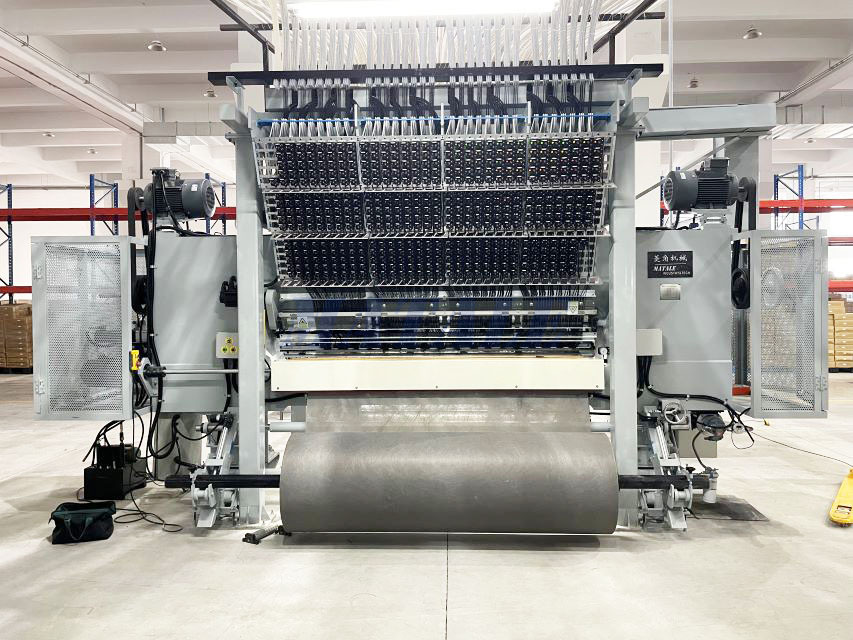
Single-bar machines face hard mechanical constraints when attempting high-density, multi-color, or variable-texture structures. They are limited by the fixed physical spacing of the needles. You cannot push a single bar beyond its machined gauge. The eccentric cams and pushrods can only drive the needle bar at a specific frequency before vibration destroys the bearings.
To compensate for a fixed gauge, manufacturers often resort to costly workarounds. They aggressively alter the stitch rate to pack more yarn into the length of the carpet. This creates an unbalanced structure. The carpet becomes overly dense in the machine direction but remains sparse in the cross-machine direction. The primary backing warps under the uneven tension.
These adjustments result in compromises. The carpet quality drops. The hand-feel becomes harsh and boardy. Commercial performance ratings fall because the tufts lack lateral support. The backing may even split during the coating process due to the excessive perforations in a single linear plane.
Here are common troubleshooting steps operators take when single-bar machines fail to meet density specs:
Increase stitch rate to maximum allowable limits before backing tears.
Switch to a heavier denier yarn, risking needle friction and heat damage.
Apply heavier latex coatings during finishing to artificially boost tuft bind.
Reduce pile height to make the sparse density less visually apparent.
Adjust the jerker bar timing to pull more yarn to the face, risking pull-outs.
Change the primary backing to a heavier pick count, increasing material costs.
Mechanical solutions for complex structures fall into a few categories. Sliding needle bars offer some lateral movement for zig-zag patterns, but they slow down production speeds. Individually controlled needles provide ultimate design freedom but run at significantly lower RPMs. Multiple needle bars offer the best balance of speed and complexity.
The transition to double needle bar systems represents the industry standard. This approach achieves true composite gauge and structural versatility. It does this without sacrificing the high throughput required for profitable manufacturing. The dual bars distribute the mechanical load, allowing for higher overall stitch densities without destroying the primary backing.
A double needle bar tufting machine operates using an offset alignment of the front and rear bars. This configuration allows for fractional and composite gauges. Combining two parallel 1/4 gauge bars achieves an effective 1/8 gauge. The front bar tufts one set of lines, and the rear bar tufts the spaces in between. The stroke timing is staggered to prevent the needles from colliding.
This dual mechanical setup allows for independent control. You can manage pile heights, loop/cut textures, and stitch densities across different needle lines. The front bar can run a high loop while the rear bar runs a low loop. This creates textured patterns that single bars simply cannot replicate. The looper assemblies are also independent, allowing for cut pile on one bar and loop pile on the other.
The servo motors driving the yarn feed rollers can be programmed independently for each bar. This means you can feed yarn at different rates to the front and rear needles. This differential yarn feed is the foundation of multi-level loop patterning. The jerker bars also operate independently, controlling the yarn tension during the needle upstroke to ensure clean loop formation.
These machines possess the capacity to produce intricate, high-definition patterns. The threading and yarn feed mechanics allow a double needle bar system to function efficiently as a two color carpet machine. It embeds different colors on alternating bars. The front bar carries color A, and the rear bar carries color B.
This prevents cross-contamination. You avoid grinning and yarn entanglement. Pattern control mechanisms, such as scroll attachments, pattern wheels, or servo-driven yarn feeds, manage the yarn delivery. They pull yarn back to hide one color while pushing the other forward. This prevents the bleeding of colors between the front and back bars. The yarn is buried in the backing when not needed on the face.
The precision of the servo motors ensures that the hidden yarn does not create a bulky layer on the back of the carpet. This keeps the carpet flexible and easy to roll. The pattern software translates digital designs into precise servo movements, allowing for rapid pattern changes without mechanical retooling.
Double needle bar systems maintain competitive production speeds. They match single-bar machines even when running complex, dense structures. The dual bars distribute the penetration force over two separate strokes. This reduces the instantaneous load on the primary backing, preventing tears at high speeds.
These machines offer scalability. They handle massive commercial runs efficiently. They also adapt to short-run, custom hospitality carpet specifications. The ability to switch between different production scales enhances operational flexibility on the plant floor. You can run a 10,000-yard commercial order on Monday and a 500-yard custom hotel corridor order on Wednesday with minimal mechanical changes.
A dual gauge tufting machine provides significant design freedom. However, it introduces increased complexity in threading, tensioning, and pattern programming. You have twice as many needles to thread. You have two separate yarn feed systems to calibrate. The creel setup requires careful planning to route the yarn tubes without tangling.
Switching between different composite gauges or color palettes requires realistic assessments of changeover times. Mechanical adjustments take longer. Operators must manage intricate setup procedures. They must align the front and rear loopers perfectly to ensure consistent quality. A misalignment of even a few thousandths of an inch will cause dropped stitches or cut yarn.
The pattern programming also requires more skill. The designer must account for the physical offset between the front and rear bars. The software usually handles this offset calculation, but the operator must verify the timing marks on the machine to ensure the pattern aligns correctly on the face of the carpet.
Calculating creel overage and yarn waste during setup presents an industrial challenge. Threading two independent needle bars increases the leader waste. You need more yarn just to pull through the tubes, over the feed rollers, through the jerker bars, and down to the needles. This dead yarn is cut off and discarded before production begins.
Manufacturers must plan run lengths carefully. You have to amortize this material loss effectively over a long production run. Short runs on a dual-bar machine generate disproportionately high waste percentages. Efficient production planning minimizes waste and maximizes material yield across different carpet structures. Air splicing techniques in the creel can help reduce waste during yarn package changeovers.
Analyze the initial capital expenditure of double needle bar technology. Compare this against the long-term ROI gained through reduced yarn waste and access to higher-margin commercial carpet markets. The ability to produce premium patterned carpets justifies the higher initial investment. You can bid on complex architectural specifications that single-bar shops cannot touch.
Maintenance requirements increase with dual bars. You must monitor needle wear patterns on both bars. Dual looper and hook alignment requires precision tools. You must factor in the cost of specialized replacement parts for dual-bar systems when calculating long-term profitability. The bed plate, loopers, and knives all experience wear and require regular grinding or replacement to maintain cut quality.
Uneven yarn tension between the front and rear needle bars poses a primary adoption risk. It causes structural inconsistencies. You will see high/low pile defects or pattern skewing across the width of the carpet. If the front bar pulls tighter than the rear bar, the carpet will bow.
Mitigation strategies require precision equipment. Utilize precision yarn feed attachments, such as positive-feed rollers. Implement automated tension monitoring systems. Load cells can detect tension spikes and alert operators before defects occur. Consistent yarn delivery is mandatory for dual-bar success. The yarn must flow freely from the creel, through the anti-static guides, and into the feed rollers without snagging.
The jerker bar timing is critical here. It must pull the exact amount of slack required for the needle stroke. If the jerker bar is timed too early, it pulls the yarn out of the looper. If it is timed too late, the yarn loops loosely on the back of the carpet, creating a tripping hazard and wasting material.
Calibrating a double needle bar tufting machine involves a steep learning curve. Operators require specific training. They must manage dual needle timing. Hook-to-needle clearance must be set independently for both bars. Knife synchronization in a dual-bar cut-pile setup requires extreme precision. The knives must shear the yarn against the looper at the exact moment of maximum loop extension.
Calibrating stroke depth and needle plate settings prevents needle deflection. When penetrating heavy primary backings at high composite densities, needles can bend. This leads to needle-to-looper collisions. Proper calibration of the bed plate height and stroke limits prevents this catastrophic damage. Operators use feeler gauges to set the clearance between the needle scarf and the looper point, usually aiming for a gap of 0.002 to 0.005 inches.
Regular maintenance schedules must be strictly enforced. The eccentric cams require constant lubrication. The pushrods must be checked for play. Any slop in the mechanical drive system will translate into uneven pile heights on the finished carpet. The dual-bar system amplifies any mechanical wear, making preventive maintenance a daily requirement.
Request sample runs with specific yarn deniers to verify structural integrity and backing compatibility before committing to a full production schedule.
Conduct time-studies on threading changeovers to accurately assess operational efficiency and labor costs associated with dual-bar setups.
Consult with OEM engineers to calibrate stroke depth and needle plate settings for your specific primary backing materials.
Implement rigorous operator training programs focused exclusively on dual-bar looper timing, knife synchronization, and tension management.
A: Gauge refers to the fixed physical distance between needles on a single bar. Composite gauge is the effective, tighter density achieved using multi-bar, staggered, or offset techniques within the same carpet structure.
A: It achieves variable density through the offset physical alignment of two needle bars and independent yarn feed control. This allows different stitch rates, pile heights, and yarn tensions across the width of the carpet.
A: Yes, it can run single-gauge structures by threading only one bar. However, operational efficiency and setup times must be considered, as running a dual-bar machine for single-bar work underutilizes the equipment.
A: Compatible yarn sizes depend on the effective composite gauge and needle eye size. The maximum yarn denier must pass through the needles without excessive friction to prevent filament breakage and heat buildup.
A: Grinning occurs due to a mismatch between the composite gauge, yarn denier, and stitch rate. Undersized yarn or insufficient stitch density fails to provide adequate pile coverage over the primary backing.